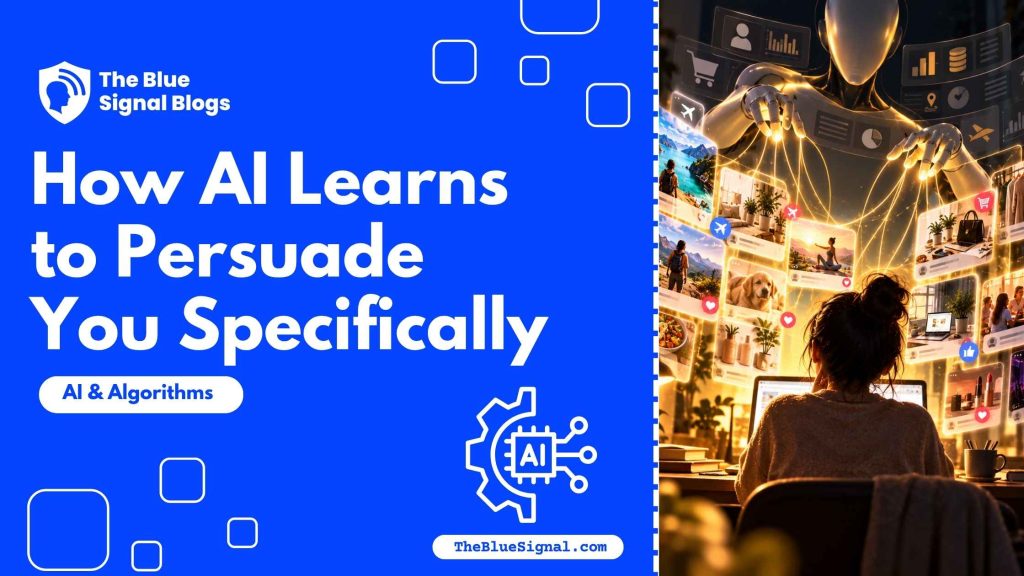

AI persuasion means the ad you just saw was not designed for everyone who uses that platform. It was built for you specifically, shaped by what a system has inferred about your fears, your desires, and your emotional state right now.
Nobody sat down and wrote that message with you in mind. A system did, working from patterns in your own behaviour that you never consciously handed over.
That distinction matters more than it sounds like it should.
This post covers how AI optimises a persuasion message specifically for you, how it predicts vulnerability and targets it, how emotional triggers get identified and activated by algorithms, and what all of this means for your everyday decision-making. It is part of our wider guide to how AI and algorithms quietly shape what you think and buy.

How Does AI Optimise a Persuasion Message Specifically for You?
A modern ad system does not write one message and show it to everyone. It generates many small variations of the same message and tests them against real behaviour, keeping whichever version earns the strongest reaction from a given type of person.
AI persuasion works by treating you as a specific profile rather than a member of a broad audience, built from your past clicks, your purchase history, your location, and even how long you paused on a previous post before scrolling on.
The European Commission fined Google €2.95 billion in September 2025 for abusing its dominance in advertising technology, finding that its AI-powered ad systems had systematically steered advertisers toward its own exchange, reducing competition and raising the cost and opacity of digital advertising for everyone involved.
Global digital advertising revenue exceeded 700 billion dollars in 2025, roughly ₹58 lakh crore at current exchange rates, with AI-powered personalisation enabling micro-targeted persuasion at a scale that was simply not possible a decade earlier, according to the Georgetown Law Denny Center for Democratic Capitalism.
None of this requires a human copywriter to study you personally. The system does that work automatically, at a volume no team of writers could ever match.

How Does AI Predict Vulnerability and Target It?
A system built to maximise engagement learns, indirectly, which moments make a person more receptive to a given message, a late night scroll, a stressful week, a recent search that revealed a specific worry.
This connects closely to the data pipeline covered in more depth in our guide to how every ad you see was built from your personal data, since prediction depends entirely on the profile that pipeline has already assembled.
Financial stress, health anxiety, and loneliness are all patterns a well-trained system can infer indirectly, from browsing behaviour alone, without ever being told any of it directly by the person concerned.
Once a vulnerability is inferred, the system does not need to state it outright. A message timed to arrive during exactly that moment of receptiveness does most of the work quietly, without ever naming the fear it is responding to.
This is precisely why the same product can appear to different people as urgent and essential or entirely unremarkable. The underlying vulnerability being targeted differs from one person to the next, even when the product itself does not.
A person searching for information about debt sees a very different framing of the same loan product than someone browsing for a holiday upgrade, and neither of them typically realises the framing itself was chosen specifically for them.

How Are Emotional Triggers Identified and Activated by Algorithms?
Fear, urgency, desire, and social comparison are the emotional levers a persuasion system tests most heavily, since each reliably produces a faster, more decisive reaction than a neutral, purely informational message ever does.
A message built around fear of missing out reads differently to someone who has just searched for job security than it does to someone who has just booked a holiday, and the system adjusts the framing accordingly, automatically, without a human ever choosing the wording by hand.
Political advertising exploits this exact mechanism too, a subject covered in more depth in our guide to how political ads are personalised to your fears without you knowing, since a microtargeted political message and a microtargeted sales message are built from the same underlying playbook.
The Markup, a non-profit investigative newsroom, publishes accessible research on exactly which tracking and targeting systems power this kind of emotional profiling, and offers a free tool that scans any website for the trackers behind it.
None of this is inherently illegal. It is simply persuasion built with far more precision, and far more knowledge of a specific individual, than any advertisement could ever have carried before.

What Does Personalised Persuasion Mean for Your Decision-Making?
Personalised persuasion is not simply an advertising feature. Increasingly, it is the actual product a platform sells to whoever is willing to pay for access to your specific attention.
Understanding that every targeted message reaching you has been optimised specifically for your psychological profile changes how you receive it, since a decision that felt entirely your own may have been nudged toward a particular outcome well before you consciously weighed anything at all.
This connects to the behavioural profiling covered in more depth in our guide to how data brokers know more about you than you do, since the profile behind a persuasive message and the profile sold to a data broker are often built from the very same underlying data.
Pausing before a decision that arrived through a personalised ad, and asking whether you would still want this without the timing and framing that made it feel urgent, restores at least some of the deliberation the system was specifically designed to bypass.
That pause costs almost nothing, and it is precisely the step a system built for speed and immediate reaction is counting on you to skip.
If a personalised message has already led you into a fraudulent purchase or investment, report it as soon as possible through India’s National Cyber Crime Reporting Portal or the 1930 helpline.

Frequently Asked Questions
Is AI persuasion the same thing as ordinary advertising?
Not quite. Ordinary advertising targets broad groups. AI persuasion builds a message around your specific inferred fears, desires and vulnerabilities, tested and refined against your own past behaviour.
Can I actually stop this kind of targeting?
You can reduce it by limiting ad personalisation settings on major platforms and clearing tracking data regularly, though most systems will still infer a partial profile from whatever behaviour remains visible.
Why does the same ad feel so different to different people?
Because it usually is different. AI persuasion generates many versions of one message and shows each person whichever version was optimised for their specific inferred emotional state.
What This Comes Down To
AI persuasion is not a feature bolted onto advertising. For a growing share of the industry, it is the actual product, built from a profile of you that was assembled long before any specific message ever reached your screen.
The one habit that helps most: notice when a message feels unusually urgent or personally relevant, and treat that feeling itself as a cue to slow down rather than as proof the message deserves your trust.
If this was useful, share it with someone who needs to know.