
Telling real news from fake starts the moment something makes you feel outrage, fear, or disbelief, and your thumb is already moving toward the share button before you’ve finished the second paragraph.
That reaction is not an accident. Noticing it is the whole starting point, since the emotional pull is often the clearest signal that something deserves a second look before it deserves a forward.
This post covers the spectrum from false news to misleading framing to plain opinion, why emotional content spreads faster than the correction that follows it, how to evaluate a source rather than a single claim, and the checklist worth running before you share anything. It is part of our wider guide to how fake messages, emails and calls deceive people every day.

Where Does a Claim Sit Between False News, Misleading News and Opinion?
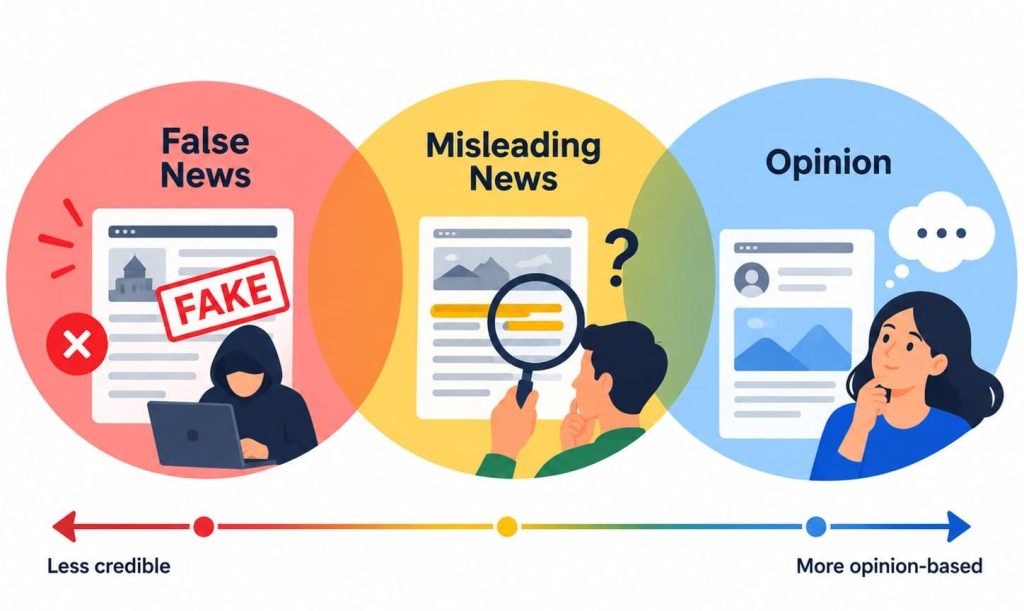
Outright false news is the easiest category to define, a fabricated event or statistic presented as fact, with no basis in anything that actually happened.
Misleading news sits in a murkier middle ground, a real event reported with selective framing, a headline that technically matches the story while implying something the article itself does not actually support.
Opinion sits at the far end of the spectrum, clearly the writer’s own interpretation, though it is often the category most easily disguised as straight reporting when the formatting looks similar enough.
Most misleading content in circulation sits closer to the middle of this spectrum than to outright fabrication, a genuine photo attached to the wrong event, or a real statistic quoted without the context that would change how it reads.
Telling real news from fake means noticing which of these three categories a piece of content actually falls into, since the difference changes how much weight it deserves before you form a view or pass it along.
Why Does Emotional Content Spread Faster Than Factual Corrections?
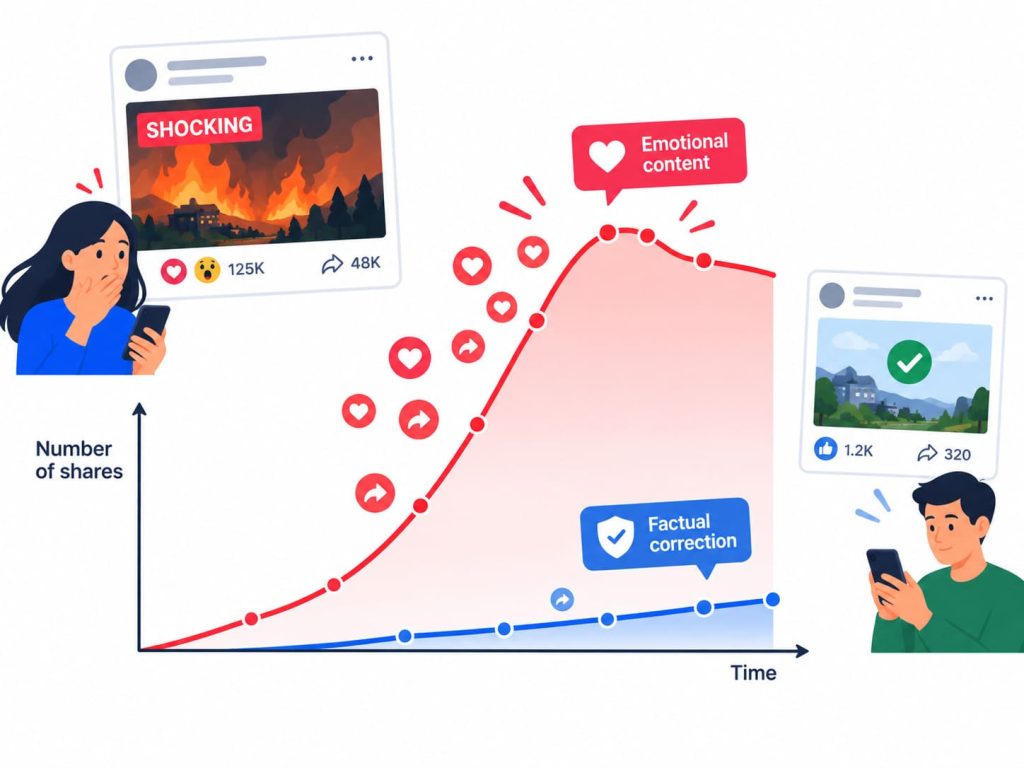
Content built to make you feel outrage, fear, or disbelief spreads roughly six times faster than the factual correction that eventually follows it, according to MIT Media Lab research cited in the Reuters Institute’s Digital News Report 2025.
By the time a correction is published, the original claim has usually already reached the audience it was going to reach. This asymmetry is exactly why telling real news from fake before you share matters more than correcting it after the fact.
Algorithmically amplified misinformation reached an estimated 1.5 billion people globally across 2024 and 2025, meaning most people who encounter false content never see the correction reach them at all.
Coordinated disinformation campaigns exploit exactly this gap, deliberately seeding emotionally charged claims across many accounts at once, sometimes through what looks like a genuine grassroots movement but is actually a single coordinated effort, a tactic known as astroturfing.
A single well-organised campaign can post through dozens of accounts within minutes of each other, creating the appearance of widespread, independent agreement where none genuinely exists.
Deepfake news anchors have added a newer layer to this problem, synthetic presenters reading fabricated headlines with complete on-screen confidence, a specific technology covered in more depth in our guide to deepfakes and AI deception, when you can’t trust what you see or hear. Several major platforms updated their policies through 2025 to require labelling of AI-generated content, though enforcement across the board remained inconsistent.
How Do You Evaluate a Source, Not Just a Single Claim?
Checking who published a piece, and what else they have published recently, reveals far more than fact-checking one isolated claim in isolation ever could.
Sponsored journalism and advertorial content disguised as ordinary reporting deserve a specific check, a small “sponsored” or “paid partnership” label that is easy to miss when scrolling quickly.
Media ownership shapes coverage too, commercial and political interests behind a publication can quietly influence what does and does not get reported, without a single individual story containing an outright falsehood.
Checking whether a story has a named author, a correction policy, and a clear separation between news and opinion sections is a quick, practical way to gauge a publication’s overall editorial standards.
A source that consistently amplifies only one side of every issue, or that exists purely to push a single narrative, is worth treating with more caution than a single well-written article might suggest on its own, a pattern that connects closely to the filter bubbles covered in our guide to whether you’re living in a filter bubble without knowing it.
Organisations such as First Draft News publish accessible, practical guides specifically for verifying claims, identifying manipulated images, and understanding coordinated disinformation campaigns in more depth than a single checklist can cover.

What Should Be on Your Before-You-Share Checklist?
Notice the emotional pull first. If a piece of content makes you want to share it immediately, that urgency itself is worth pausing on before you act on it.
Check whether other credible, independent outlets are reporting the same story, since a genuinely major event is rarely covered by only one obscure source.
Notice the source of any statistic or figure specifically, and be wary of a claim that quotes a number with no named study, agency, or report behind it at all.
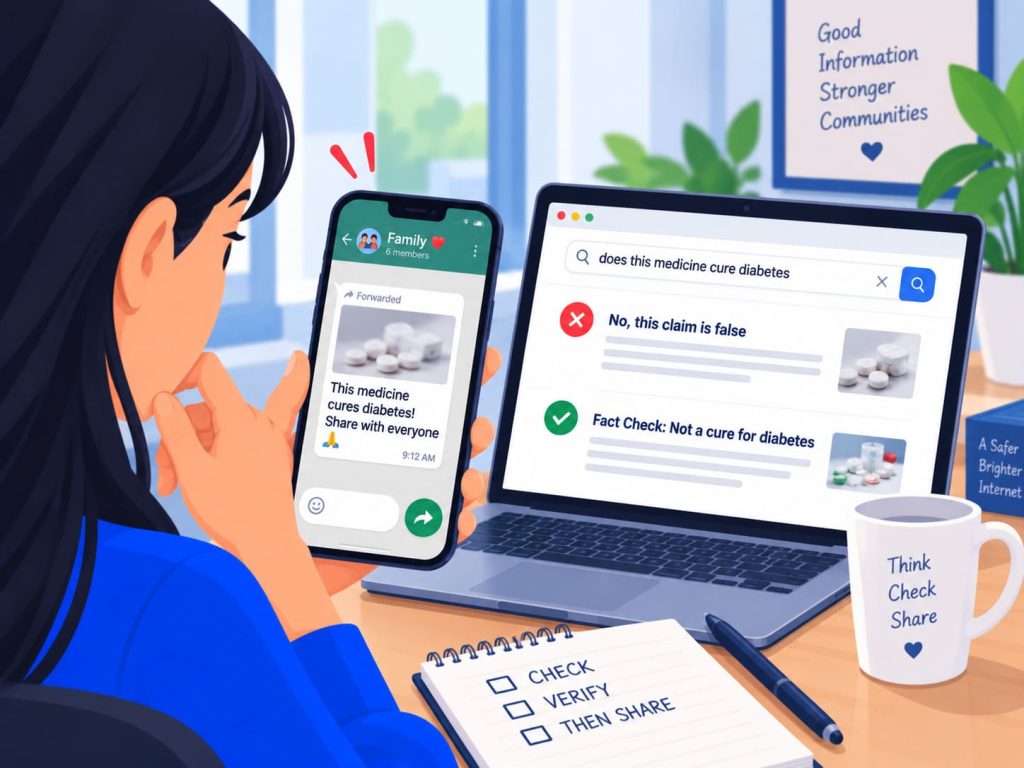
Search the claim directly rather than trusting a screenshot or forwarded WhatsApp message, since screenshots strip away the context and correction history a live article would normally carry.
For anything involving Indian government policy, official statements, or viral claims about public schemes, the Press Information Bureau’s PIB Fact Check unit verifies specific claims directly and publishes its findings publicly within days.
Political content deserves an extra layer of scrutiny, since deliberate microtargeting is now a documented part of how some political messaging is deployed, a subject covered in more depth in our guide to how political ads are personalised to your fears without you knowing. A message engineered specifically to match your own fears is worth reading with that in mind before deciding how much weight to give it.
Frequently Asked Questions
How can I quickly check if a WhatsApp forward is real news or fake?
Search the core claim independently rather than trusting the forward itself, and check whether independent, credible outlets are reporting the same story. A claim appearing nowhere else is a strong warning sign.
Why do I feel compelled to share something before checking if it’s true?
Content designed to trigger outrage, fear, or disbelief is built specifically to spread before anyone stops to verify it. That urgency is itself the signal worth noticing.
Is sponsored content the same thing as fake news?
Not exactly. Sponsored or advertorial content is disclosed paid promotion rather than fabricated fact, but it can still be misleading if the disclosure is easy to miss, so it deserves the same close read.
What This Comes Down To
Telling real news from fake rarely comes down to spotting one obvious lie sitting in plain sight. It comes down to noticing your own reaction and checking the source before you pass anything along to someone else.
The one habit that protects you and the people you share with: pause on the urge to share immediately, and verify independently before you forward anything to a family or friend group.
If this was useful, share it with someone who needs to know.