

It can start as a single unkind comment, or with dozens of hostile messages arriving at once. It can come from a stranger organising an attack in a private group chat, or from someone close to you who already knows your daily routine. Online harassment and abuse take several distinct forms, and the right response depends on which one you are facing.
Online harassment and abuse take several distinct forms, and the right response depends heavily on which form you are actually facing. Treating coordinated harassment the way you would treat a stalking situation, or treating a reputation attack the way you would treat sextortion, can waste precious time when a more specific response would serve you better.
This guide covers five distinct patterns: coordinated pile-ons and doxxing, stalking by people you know, sextortion and image-based abuse, grooming and child exploitation, and reputation attacks that follow you long after the original incident.
Each section links to a full guide with specific, practical steps. If you are currently facing any of these situations, know this first: none of it is your fault, and there are concrete, documented steps that help.

Why Do These Five Patterns Belong in One Guide?
Each form of online harm in this section shares a common structure, even though the specific harm differs enormously. Someone exploits a channel you trusted, a message, a shared location, a private image, a childhood relationship, a public reputation, and uses it against you.
They also share a common recovery principle: documentation matters immediately, in every single case. Screenshots, dates, and specific details, gathered before content disappears or a situation escalates, are what make every subsequent report, protective order, or takedown request actually work.
58.2% of US teens report experiencing cyberbullying in their lifetime, and 71% of online harassment targets change their behaviour afterward, posting less or withdrawing from platforms, according to research cited across this section. These numbers reflect how common these experiences are, not how unusual you are for facing one.
None of the five patterns below are random. Each is organised, deliberate, and increasingly well documented, which means each one also has a documented, practical response.
One distinction worth making early: harm from a stranger and harm from someone you know require different instincts. A stranger’s coordinated pile-on can often be reduced through platform reporting, blocking, and reducing your visible surface area. Harm from someone who already knows your routine, your address, your family, cannot be solved the same way, since blocking one account does nothing about the underlying access that person still has to your life. Recognising which category you are in early changes which of the five sections below deserves your attention first.
It also helps to separate the emotional weight of what happened from the practical sequence of what to do next. These are not the same task, and trying to do both at once, process the fear or shame while also documenting evidence correctly, is genuinely difficult. Where possible, having a trusted person help with the practical steps while you focus on your own safety and wellbeing tends to produce a more complete record than trying to manage everything alone.
Platform reporting tools also vary considerably in how well they actually work, and it is worth knowing that upfront rather than treating a single ignored report as proof that nothing can be done. A report that gets no response within a reasonable window is worth escalating, either to a platform’s trust and safety team directly where one exists, or to a relevant national authority, rather than treated as a dead end.
What Does a Coordinated Harassment Campaign Actually Look Like?
Coordinated pile-ons are frequently planned in private group chats before being unleashed publicly, with organisers sharing a target’s profile and suggested messages to maximise the overwhelming effect. Doxxing, publishing private information to enable offline harm, and swatting, fake emergency calls sent to a real address, are the most dangerous escalations within this pattern.
The DOJ indicted five individuals tied to the “764” network in December 2025, including an active-duty US Navy sailor, for operating coordinated harassment and exploitation rings across multiple platforms simultaneously, showing how organised these campaigns can become.
What makes coordinated campaigns especially difficult to defend against is the sheer volume arriving at once, which is deliberate. A single hostile message is easy to dismiss or report. Two hundred arriving within an hour, from accounts that appear unconnected, overwhelm both the target’s ability to respond and any single platform’s ability to act quickly, since each report looks like an isolated incident rather than part of an organised campaign unless someone specifically connects the pattern.
Stepping back from the specific platform for a moment or two before responding to any single message in a pile-on is one of the few genuinely useful immediate actions, since organisers often design the first wave specifically to provoke a reaction that then becomes new ammunition for the next wave.
Read the full guide: Doxxing, Swatting and Online Pile-Ons: How Coordinated Harassment Works

Could Someone You Know Be Tracking You Digitally?
Digital stalking is most often carried out by someone the victim already knows, and it typically escalates gradually, starting with small, oddly specific details before building into a recognisable pattern. Location tracking and stalkerware are the two technical mechanisms that most commonly enable it.
Roughly one in ten people has experienced some form of tech-enabled stalking, with former intimate partners the most common perpetrators, and digital monitoring frequently precedes physical escalation rather than replacing it, which is why early documentation matters as much for safety as for any eventual protective order.
The specific detail that most often confirms digital stalking, rather than coincidence or paranoia, is knowledge that could only come from tracking. If someone consistently knows where you were, who you were with, or what you said in a private conversation without any plausible way of having been told directly, that pattern is worth taking seriously rather than explaining away. Shared location settings from an old relationship, a forgotten device connection, or stalkerware installed during a period of access are the three most commonly documented sources.
A useful reframe here: trust your own pattern-recognition before you trust an explanation that requires an unlikely coincidence. People who are being tracked frequently talk themselves out of the conclusion for weeks specifically because the alternative, that someone they know is monitoring them, feels harder to accept than believing it was a fluke.
Read the full guide: Digital Stalking: How to Recognise It and What to Do

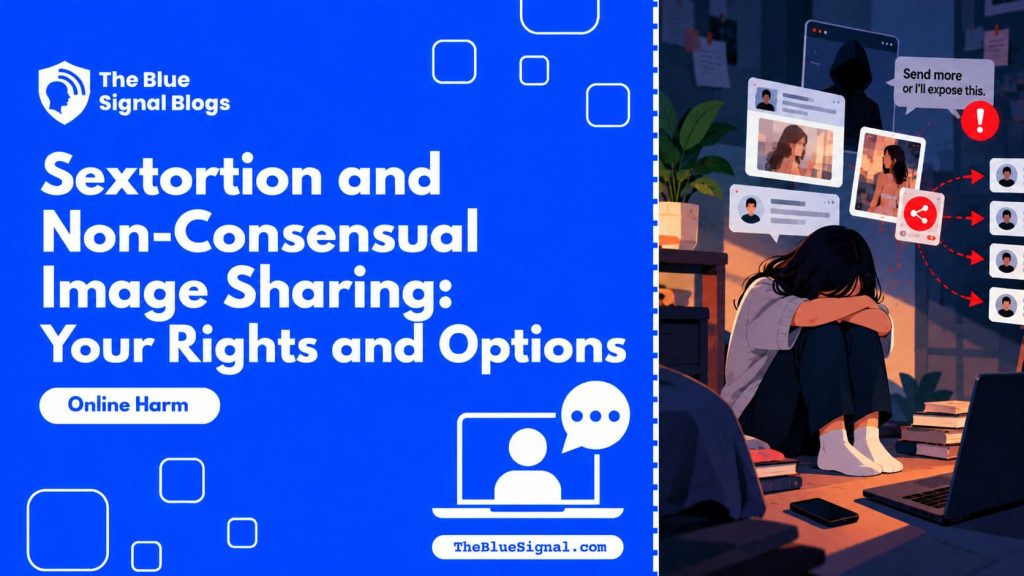
What Should You Do if You’re Facing a Sextortion Threat?
Sextortion is a crime committed against you, regardless of how any image or video came to exist. Paying a demand does not stop it, it confirms you will pay, which is why the most effective documented response is to stop engaging entirely, document everything, and report immediately rather than negotiate.
NCMEC received an average of 137 financial sextortion reports per day in 2025, a 37% increase over the prior year, with most victims being teenage boys between fourteen and seventeen. Deepfake pornography extends the same harm to fabricated content, and both real and fabricated non-consensual images can generally be reported and removed through the same channels.
StopNCII and similar hash-matching services let a person generate a digital fingerprint of an image without ever uploading the image itself, which participating platforms then use to block matching content automatically. This matters specifically because it removes the need to send the image anywhere a second time in order to get help removing it.
The shame that sextortion is specifically designed to produce is the same shame that keeps most victims from reporting it quickly, which is exactly the outcome the person demanding payment is counting on. Every documented case pattern shows the same escalation: payment does not end the threat, it confirms the target will pay, which typically increases the demand rather than resolving it. The uncomfortable truth worth stating plainly is that reporting immediately, even though it feels exposing, consistently produces better outcomes than trying to handle it alone.
Read the full guide: Sextortion and Non-Consensual Image Sharing: Your Rights and Options

How Does Grooming Actually Happen, and What Should Parents Watch For?
Online grooming is built specifically to look like friendship, not danger, escalating gradually enough that no single interaction feels alarming on its own. Isolation from protective adults, a child becoming secretive about one specific online relationship, is the clearest warning sign across documented cases.
This connection is built deliberately over weeks or months through gaming and messaging platforms, often accelerated by the platform’s own recommendation systems, and framing conversations around specific patterns, like secrecy, rather than general suspicion of adults, tends to keep children more willing to speak up when something feels wrong.
Roblox lawsuit filings in 2025 documented researcher-created child accounts reaching communities linked to further exploitation within minutes of joining, a finding that reflects how quickly a platform’s own structure, recommendation systems, open chat, easy account creation, can accelerate contact once a predator identifies a target. This is not a reason to remove every device from a child’s life, but it is a strong argument for treating platform-level settings, not just conversations, as part of the actual protection.
Read the full guide: Online Grooming: What Parents Need to Know to Protect Their Children

None of this requires constant surveillance of a child’s every message to be effective. Focusing conversations on secrecy specifically, “has anyone ever asked you to keep a conversation just between the two of you”, tends to surface far more useful information than a general question about strangers online, since grooming relies specifically on secrecy as its core mechanism rather than on any single obviously alarming message.
Can a False Accusation Ever Be Fully Erased Online?
Rarely completely, once it has spread across screenshots and reposts, which is why the realistic goal shifts from full erasure to containment and steadily building an accurate record over time. Content that violates specific platform policies can often be removed, but genuine opinion, however unfair it feels, generally cannot.
71% of online harassment targets change their behaviour afterward, posting less or withdrawing from platforms entirely, according to Pew Research Center’s Digital Harassment Report, a figure worth sitting with because it shows how effectively these campaigns achieve their goal even without a single claim ever being proven true. Search engine results, not the original post itself, are usually what does the lasting damage, since most people encounter the accusation through a search rather than the platform it started on, which is exactly why building a steady, accurate, searchable record over time matters more than any single takedown request.
Read the full guide: False Accusations and Online Reputation Attacks: How to Respond

For further reading across this section, NCMEC, the Cyberbullying Research Center, Crash Override Network each offer additional depth.
Frequently Asked Questions
Should I always involve the police in online harassment?
It depends on severity and the specific threat involved. Credible threats of violence, sextortion, swatting risk, and stalking with a physical safety dimension generally warrant police involvement directly. Less severe harassment may be better addressed first through platform reporting and documentation.
What is the single most important first step across all five patterns?
Documentation, consistently. Screenshots, dates, and specific details gathered immediately, before content disappears, are what make every subsequent report, protective order, or takedown request actually effective later.
None of these five patterns are random, and none of them reflect something you did wrong. Each is organised and documented, which means each one also has a documented, practical response.
The shift worth making is from feeling like a target with no options to recognising yourself as someone following a known, documented response to a known, documented pattern. That framing is not just comforting language, it reflects the actual state of the evidence: none of these five forms of harm are new or mysterious to the organisations built to respond to them.
Start with whichever pattern in this guide matches what you are currently facing, and go read that full guide next.
If this was useful, share it with someone who needs to know.


4 comments
Comments are closed.