

You tell yourself you will check the app for one minute. Forty minutes later you look up, not entirely sure how the time passed or what you were even looking for. That gap between intention and outcome is a genuine sign of digital addiction.
Digital addiction is a stronger, more accurate term than most people are comfortable using, yet the mechanism behind it is well documented and deliberately built into the products producing it. This is not a personal failure of willpower.
Understanding the specific reward mechanism at work does not make it disappear, but it does make it possible to interrupt, which is a meaningfully different and more achievable goal than trying to out-willpower a system built by teams of specialists to resist exactly that.
This post explains variable reward and dopamine’s actual role, how compulsive checking gets built and reinforced, and specific, practical ways to loosen its grip without requiring total abstinence. This is part of the wider picture covered in how platforms exploit your brain.

What Is Variable Reward, and Why Is It So Effective?
Variable reward means you do not know in advance whether checking an app will produce something rewarding, a like, an interesting post, a message, or nothing at all. This uncertainty is precisely what makes the behaviour so compelling, more so than a guaranteed reward would.
Slot machines rely on the exact same mechanism, and it is not a coincidence that former slot machine designers have gone on to consult for technology companies building notification and feed systems, applying the same principle to a screen most people carry constantly.
A predictable reward, checking your email and always finding exactly one new message, would not produce the same compulsive checking pattern. It is specifically the unpredictability that keeps a person checking far more often than any rational assessment of the odds would justify.
This is why feed design has moved so consistently toward infinite, algorithmically shuffled content rather than a fixed, chronological list. A shuffled feed guarantees that no two checks ever look identical, keeping the variable reward mechanism firing on every single visit rather than settling into a predictable pattern.
Gaming and gambling-adjacent apps push this mechanism further still, using loot boxes, spinning reward wheels, and randomised in-app drops that mirror casino mechanics almost exactly, which is part of why several countries have begun examining these features under gambling regulation rather than treating them as ordinary game design.

What Role Does Dopamine Actually Play in This?
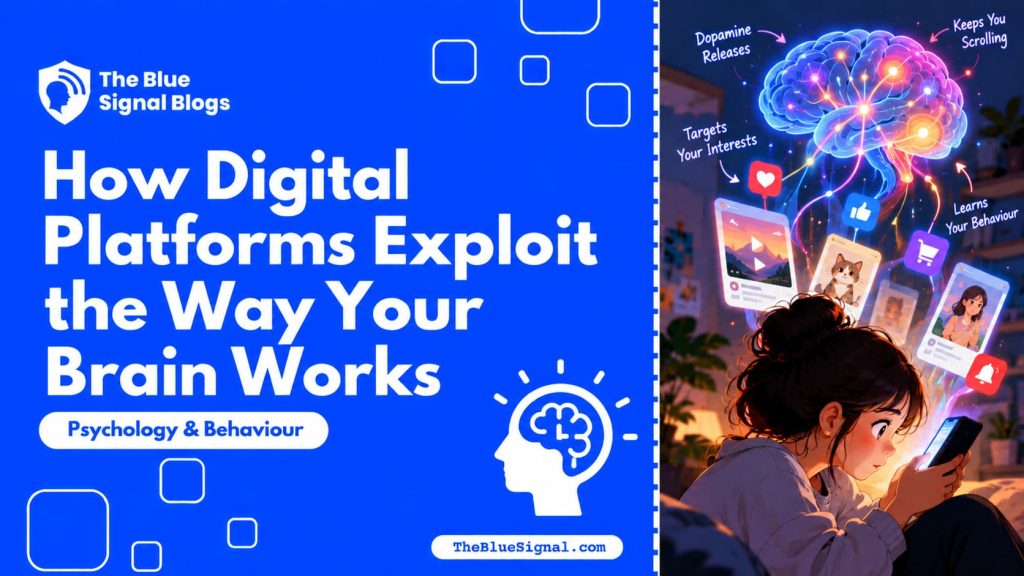
Dopamine is frequently misdescribed as a pleasure chemical, but its more accurate role is anticipation, the drive to seek out a reward rather than the enjoyment of receiving it. This distinction matters, because it explains why checking an app can feel compelling even when the content you find is rarely satisfying.
The anticipation itself, the small mental pull of “there might be something interesting,” is what drives repeated checking, and apps are specifically designed with cues, badges, red notification dots, subtle animations, that trigger this anticipatory response as often as possible throughout the day.
This connects to how infinite scroll and notifications are engineered to keep you hooked, since these two mechanisms, variable reward and dopamine-driven anticipation, are the underlying engine that infinite scroll design specifically exploits.
This is also why simply “trying harder” to resist rarely works on its own. The anticipatory pull operates below the level of conscious decision-making, which is why removing or weakening the external trigger tends to be far more effective than relying on willpower to override an urge after it has already fired.

How Does Compulsive Checking Actually Get Built and Reinforced?
Each notification, each red badge, each brief moment of boredom filled by a reflexive check strengthens the same neural pathway slightly further, the same way any repeated habit strengthens with repetition, regardless of whether the person consciously intends to build it.
Over weeks and months, checking stops requiring a conscious decision at all. It becomes the default response to boredom, mild discomfort, or even a few seconds of unstructured waiting, which is precisely the automatic, low-friction behaviour the underlying design is built to produce.
This mirrors patterns covered in the boiling frog problem and gradual boundary erosion, since compulsive checking rarely arrives as a sudden shift. It builds gradually enough that most people do not notice the exact point at which it became automatic.

What Actually Works to Loosen the Grip, Without Requiring Total Abstinence?
Turn off non-essential notifications specifically, rather than trying to reduce overall app usage through willpower alone, since removing the external trigger is measurably more effective than trying to resist a trigger that keeps firing.
Move high-pull apps off your home screen, adding a small amount of friction between impulse and access. This friction is often enough to interrupt a fully automatic checking habit, giving you a brief window to notice the impulse before acting on it.
Track your actual checking frequency for a few days without trying to change it first, simply noticing and logging each instance, since most people significantly underestimate how often they check until they see the honest count in front of them, and that honest baseline is often what makes the pattern feel worth addressing in the first place.
Replace the specific moments that trigger checking, waiting in a queue, a lull in conversation, with a different small action, rather than leaving that gap unfilled, since an empty gap is precisely what the checking habit has learned to fill by default.
Set specific device-free windows around sleep and the first part of your morning, since checking immediately before bed and immediately on waking are two of the most consistently reinforced trigger points, and disrupting even one of them tends to noticeably weaken the automatic pull at other points during the day.
For further reading, the American Psychological Association, the Center for Humane Technology, and Common Sense Media each cover this topic in more depth.

Frequently Asked Questions
Is digital addiction a real clinical diagnosis?
Formal diagnostic recognition varies by country and specific behaviour, gaming disorder is recognised by the World Health Organization, while broader “social media addiction” remains under active research. Regardless of formal diagnostic status, the underlying compulsive checking mechanism is well documented and measurable.
Do notification-blocking apps actually help long term?
They help most as an initial tool to reduce the external trigger, though the underlying habit still needs to be actively replaced with something else, since removing a trigger alone does not automatically dissolve an already-automatic behaviour pattern.
Digital addiction is not a personal willpower failure. It is a deliberately engineered response to variable reward and dopamine-driven anticipation, built by design teams who tested it specifically to be effective.
To interrupt digital addiction where it actually starts, pick one high-pull app right now and turn off its non-essential notifications before you finish reading this sentence, then notice how the urge to check it changes over the next few days, and how much of that urge was ever genuinely about the app itself rather than the notification habit engineered to sit quietly around it, waiting for a reason to pull you back.
If this was useful, share it with someone who needs to know.


1 comment
Comments are closed.