

You searched for one product once, and it followed you across the internet for weeks. An influencer you trust recommended something with real enthusiasm, and you had no way to tell whether that enthusiasm was paid for. A political ad seemed to know exactly what worried you. Advertising manipulation connects all three of those moments to the same underlying system.
None of these moments happened by chance. Each one is the visible edge of a much larger commercial system, built specifically to profile you, predict you, and sell to you with precision that would have been impossible a generation ago.
Advertising manipulation is not one trick. It is a connected set of tactics spanning data collection, disguised endorsement, emotional selling, targeting of children, political persuasion, gambling design, and the wider attention economy that funds all of it.
This guide maps out all seven, from the data pipeline behind a single targeted ad to the true cost hiding behind every “free” platform you use daily. By the end, you will know exactly where to go for a deeper look at any tactic that applies to you.

What Do All These Tactics Actually Have in Common?
Every tactic in this guide depends on the same resource: data about you, collected quietly and combined into a profile detailed enough to predict what you will respond to before you have consciously decided anything.
That profile is not built by one company acting alone. It moves through a chain of data brokers, ad exchanges, and platforms, each one adding a little more detail, until a single advertising profile can contain over 5,000 data points on one individual. The data brokerage market itself was valued at nearly 434 billion dollars in 2025, a figure that reflects just how much commercial value your attention and behaviour now carry.
The European Commission fined Google 2.95 billion euros in September 2025 for abusing its dominance across exactly this ad-tech pipeline, finding that its systems had systematically reduced competition and transparency for years. That single case shows the scale of the infrastructure behind an ad you might dismiss as background noise on a page.
Once you understand this shared foundation, each individual tactic below becomes easier to recognise, because all of them draw from the same well of data and the same underlying goal: predicting your behaviour precisely enough to change it.
None of the seven tactics below sit in isolation either. The same profiling infrastructure that targets you with a shoe ad also feeds the political microtargeting system, and the same engagement incentives that reward manufactured outrage also reward the gambling platforms designed to keep vulnerable users depositing. Once you can trace one thread back to its source, the rest of the system becomes far easier to see, because it was never really seven separate industries. It is one system, wearing seven different faces depending on what it is trying to sell you.
Regulators across multiple countries have started treating this as one connected problem too, rather than seven unrelated industries requiring seven unrelated fixes. The scale of enforcement described throughout this guide, billion-dollar fines, new disclosure rules, formal investigations into ad-tech pipelines, is a recent development, and it reflects a shift in how seriously advertising manipulation is now taken as a genuine consumer harm rather than an accepted cost of a free internet.
India’s own advertising landscape sits inside this same system, even where the specific enforcement actions covered in this guide are largely American and European. The Advertising Standards Council of India handles complaints about misleading claims domestically, and the same profiling infrastructure built by global ad-tech companies reaches Indian users through the same apps, the same platforms, and largely the same tactics described throughout this section.
How Does a Single Search Turn Into Weeks of Targeted Ads?
A tracking pixel records your click and feeds it into an ad network the moment you interact with a page. Retargeting then turns that single signal into a standing instruction, showing the same product across every site and app in that network for as long as the campaign runs.
Lookalike audiences extend your data’s influence further, using your behaviour to target people who resemble you statistically, entirely without their knowledge that your profile shaped what they see.
Your advertising profile is built from far more than search history, drawing on purchase records, location patterns, and even inferred emotional states based on what content you linger on. Most major platforms include an “ad preferences” screen that reveals at least some of what this profile currently believes about you, and reviewing it regularly is worth the ten minutes it takes.
What surprises most people who check that screen for the first time is not that they are tracked, most people already suspect that in the abstract, but how specific and occasionally wrong the resulting profile is. Seeing an inferred interest, income bracket, or relationship status you never disclosed anywhere is often what turns an abstract privacy concern into something worth actually acting on.
Read the full guide: How Every Ad You See Was Built From Your Personal Data

Is That Recommendation Genuine, or Is It Paid?
A creator’s enthusiastic recommendation and a paid advertisement can look identical, and the disclosure required by law to tell them apart is frequently left off. Only 14% of sponsored social media posts include clear, compliant disclosure language despite the legal requirement in many countries.
Native advertising compounds the problem, formatted deliberately to resemble genuine editorial content rather than a paid placement, borrowing credibility it has not actually earned.
Fake influencers add a further layer, using bought followers and bot engagement to manufacture an audience that brands then pay to access. A consistent, repeated promotion of the same brand across a short window, echoing marketing language rather than a person’s usual voice, is usually a stronger signal than the presence or absence of a tiny disclosure tag.
Read the full guide: When an Influencer Recommends Something, Is It Real or Paid?

Is That Advertisement Selling You a Product, or a Feeling?
Most advertising in the beauty, fitness, and wellness categories leads with an emotion, inadequacy addressed, aspiration fulfilled, rather than with what the product actually does. The FDA issued multiple crackdowns in 2025 on supplement brands for exaggerated, fear-based health claims lacking clinical evidence.
Identity marketing takes this further, selling products as expressions of who you are rather than tools with a function, with shame and inadequacy acting as the commercial lever underneath the pitch.
Read the full guide: How Advertisers Sell You an Emotion Instead of a Product

How Are Children Specifically Targeted by Advertisers?
Children under roughly twelve struggle to distinguish advertising from genuine content, a developmental reality that marketers account for directly. In-game advertising and loot boxes blur play and purchase so thoroughly that a child has little reasonable way to recognise the commercial intent behind them.
Multiple US states sued Roblox throughout 2025 alleging its mechanics were built specifically to exploit children’s developmental psychology, with over 40% of its 380 million monthly users under thirteen.
Pester power extends this influence past the child directly to the parent, with marketing engineered to generate repeated requests that are emotionally difficult to keep refusing. 89% of parents expressed significant concern in 2025 about how gaming and social platforms gather personal information on their children, a gap between how these products present themselves and what they actually do with a child’s attention.
Read the full guide: How Children Are Targeted Online, And What Parents Can Do

Are You Seeing the Same Political Content Everyone Else Is?
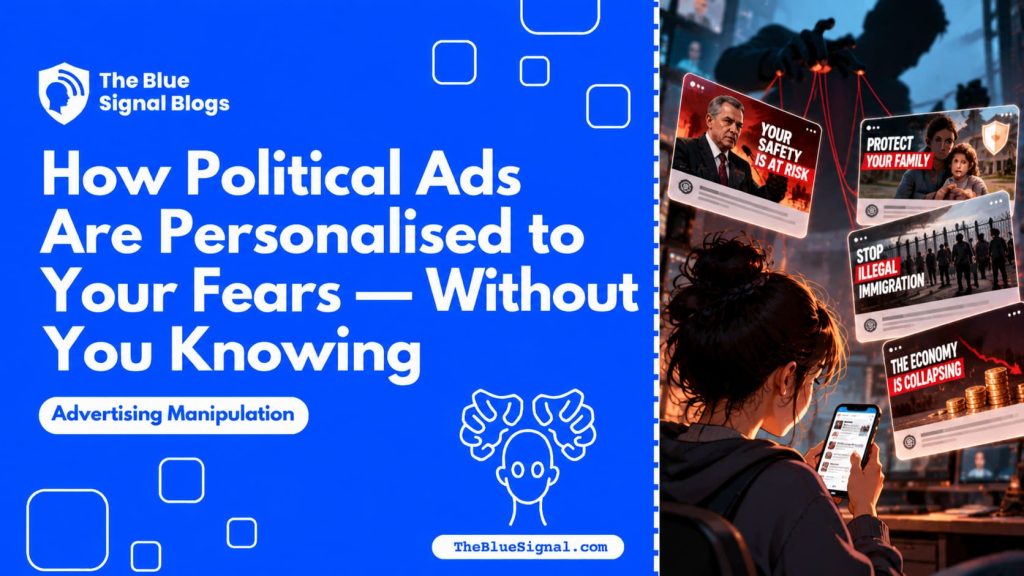
Political microtargeting means two voters in the same city can see completely contradictory messages from the same candidate, each tailored to a specific fear or value, with no public record connecting the two. Dark ads compound this, visible only to the narrow audience segment they were built for.
Cambridge Analytica’s harvesting of 87 million Facebook profiles remains the most widely known example of this kind of psychographic targeting, and its underlying methods remain legal and in active use today.
Astroturfing adds a further layer, fabricating grassroots-looking support through coordinated accounts that never disclose their funding. Independent tools like Who Targets Me can show you specifically which campaigns are targeting your own profile, making an otherwise invisible process visible for the first time.
Read the full guide: How Political Ads Are Personalised to Your Fears, Without You Knowing

Why Does Online Gambling Feel So Hard to Walk Away From?
Online gambling and fantasy sports platforms use variable reward mechanics borrowed directly from slot machines. 70% of online gambling revenue comes from the 10% of users who meet clinical criteria for problem gambling, and a 2025 BBC investigation found platforms targeting exactly those users with higher-risk offers.
Bonus and free bet offers are structured to establish a deposit habit rather than to reward loyalty, often arriving right after a losing session.
Fantasy sports occupy a legal grey area in many places, presented as a game of skill rather than gambling while using many of the same reward triggers underneath. Dedicated support services, separate from general mental health lines, exist specifically for gambling harm if this pattern feels familiar to you or someone you know.
Read the full guide: How Online Gambling Platforms Are Designed to Keep You Hooked

Why Is a “Free” Platform Never Actually Free?
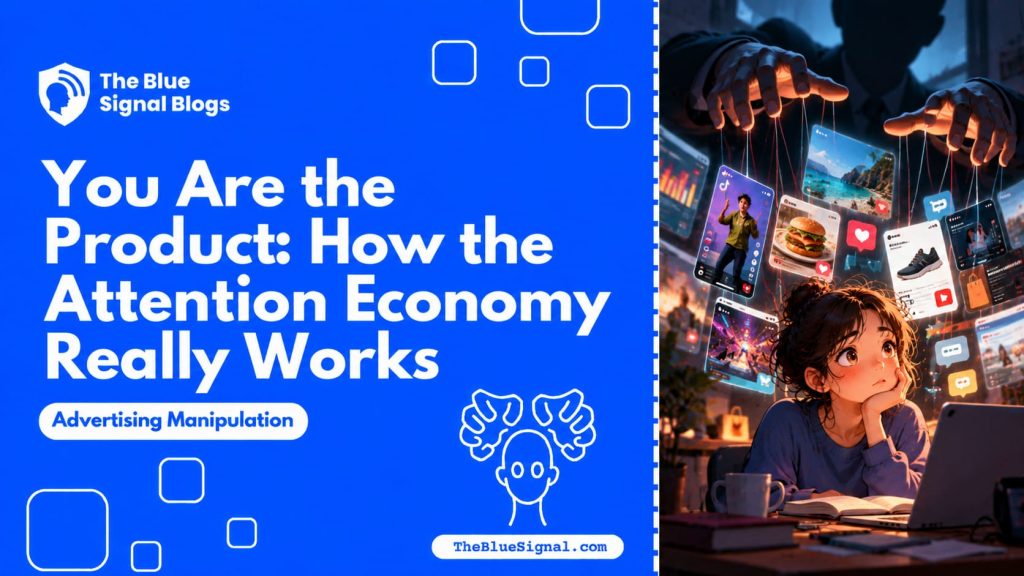
If you use a platform for free and it still earns billions, the revenue is coming from somewhere, and that somewhere is you, packaged and sold to advertisers as attention rather than paid for directly as a customer.
Social media advertising alone exceeded 230 billion dollars globally in 2025, all of it funded by user attention, data, and time. Engagement-driven incentives explain why manufactured outrage spreads faster than calm, accurate content across nearly every major platform.
The average person now spends 6 hours and 37 minutes a day on screens, with social platforms accounting for roughly 2 hours and 21 minutes of that total. None of that time is neutral. Every minute is inventory, sold once, and the design decisions covered throughout this section, infinite scroll, gamified streaks, emotionally engineered notifications, exist specifically to keep that inventory growing.
Read the full guide: You Are the Product: How the Attention Economy Really Works

For further reading across this section, the FTC’s endorsement guidance, EFF’s Surveillance Self-Defense guide, Common Sense Media’s research on marketing to children each offer additional depth.
Frequently Asked Questions
Can I actually opt out of being targeted by advertisers?
Partially. Ad preference settings on most major platforms let you limit personalisation, and device-level controls can reset or restrict your advertising identifier, but no single setting removes you from the wider data pipeline entirely.
Is targeted advertising illegal?
The core practice is legal in most countries, though specific rules around consent, disclosure, and political advertising vary significantly by jurisdiction and continue to evolve. Undisclosed sponsorships and fake reviews, by contrast, are frequently unlawful outright.
Why does this matter if the ads I see are usually harmless?
Because the same infrastructure that shows you a harmless shoe ad also shows a vulnerable gambler a personalised deposit offer, a child a disguised advertisement inside a game, and a voter a targeted political message no one else can see or fact-check.
Is there a single setting that limits most of this at once?
Not one setting, but a small handful get you most of the way there: resetting your device’s advertising identifier, turning off ad personalisation on your major accounts, and reviewing app permissions for anything requesting more access than its function needs.
Every tactic in this guide runs on the same underlying resource: a detailed profile of you, built quietly and used to predict your behaviour with increasing precision.
Seeing that pipeline clearly does not mean opting out of every ad you will ever see. It means recognising when a message was built specifically for you, and giving yourself the pause to decide whether to trust it anyway.
Start with whichever tactic in this guide felt most familiar, and read that module next.
A useful habit worth building regardless of which tactic applies most directly to you: whenever a piece of content, an ad, a recommendation, a political message, produces a strong emotional reaction almost instantly, treat that speed as information in itself. Genuine persuasion usually takes a little longer to land than a well-engineered one does.
If this was useful, share it with someone who needs to know.


7 comments
Comments are closed.