
You search for a pair of shoes once. For the next three weeks, that exact pair follows you across news sites, social media, even apps that have nothing to do with shopping. This is how ad targeting works, and it starts with a single click you barely noticed.
That is not coincidence. Understanding how ad targeting works means following a data pipeline that started building your profile long before that single search.
The ad you just saw was not chosen at random, and it was not chosen because someone guessed well. It was the output of a system that has been quietly collecting signals about you for years, from dozens of sources you never directly interacted with.
This post traces that pipeline from your browsing to the ad in front of you, and shows you how to see, and partially limit, the profile it has built. This is part of the wider picture covered in how advertising really targets you.

How Does a Single Search Turn Into Weeks of Follow-Up Ads?
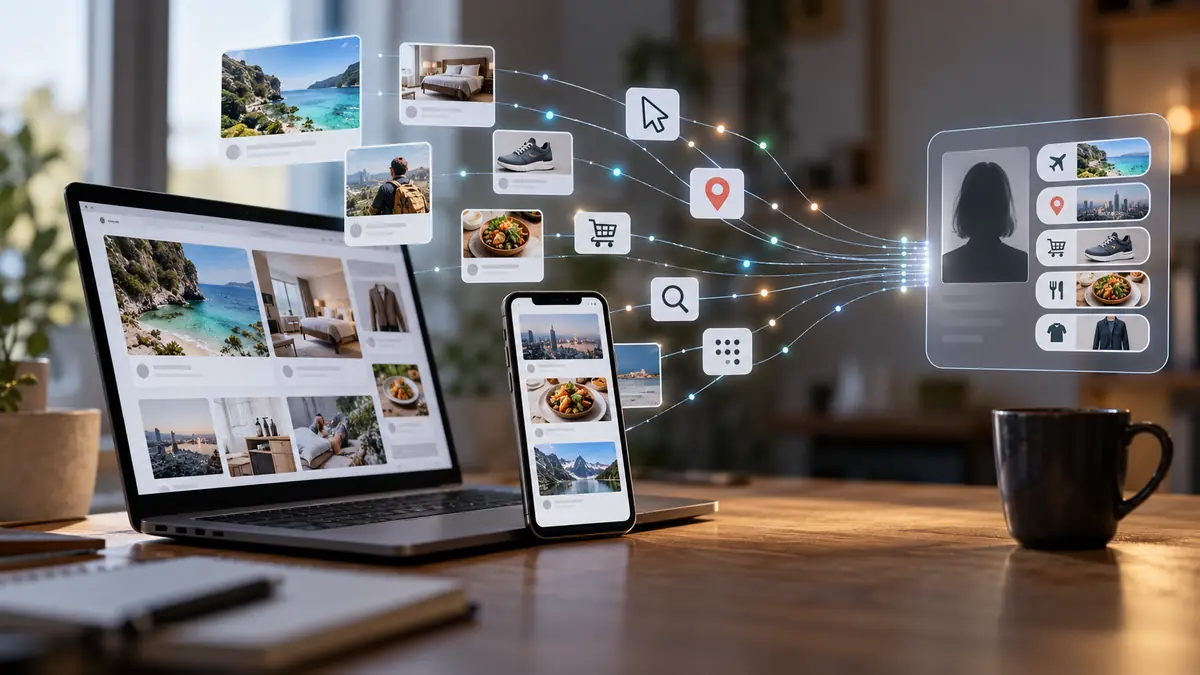
The moment you search or click, a tracking pixel or script embedded on that page records the action and sends it to an advertising network. That network does not just serve the ad on the page you were on. It shares the signal with a wider ecosystem of exchanges and data platforms.
Retargeting takes that single signal and turns it into a standing instruction: show this specific ad to this specific profile across every site and app that participates in the same ad network. This is why a product can seem to follow you for weeks after a single, brief moment of interest.
The European Commission fined Google 2.95 billion euros in September 2025 for abusing its dominance across exactly this pipeline, finding that its ad-tech systems had systematically directed advertisers toward its own exchange for years, reducing competition and transparency throughout the process.
The auction that decides which specific ad you see happens in a fraction of a second, a process called real-time bidding, where multiple advertisers automatically compete for the right to show you an ad the moment a page loads, based entirely on the profile signals available about you at that instant. This entire negotiation, invisible to the person viewing the page, is why the same webpage can show completely different ads to two people sitting side by side.
This bidding process also means your data is shared far more widely than most people assume, since every advertiser participating in a single auction receives at least some of your profile signals in order to decide whether and how much to bid, regardless of whether they ultimately win the right to show you an ad.

How Is Your Advertising Profile Actually Built?
Your profile is assembled from far more than search history. Purchase records, location data, time spent on specific content, and even inferred emotional states, based on what kind of content you linger on, all feed into a single composite picture used to predict what you might buy next.
Data brokers sit at the centre of this system, buying and combining data from multiple apps and services you never realised were connected. A single advertising profile can contain over 5,000 data points on one individual, and the data brokerage market itself was valued at nearly 434 billion dollars in 2025.
Lookalike audiences extend your profile’s influence beyond you personally. Advertisers use your data to identify people who resemble you statistically, targeting them with the same ads, entirely without their knowledge that your behaviour shaped what they are being shown. This overlaps directly with how data brokers know more about you than you do.
Offline purchase data is increasingly folded into this same profile too, loyalty card scans, warranty registrations, and even some point-of-sale systems feed information back into the same advertising ecosystem, meaning a purchase made entirely in a physical shop, with cash, can still surface later as a targeting signal online.
Household-level profiling adds a further layer many people never consider. Shared Wi-Fi networks, shared streaming accounts, and devices used by multiple family members can cause an advertising profile to blend signals from more than one person, which is part of why a household sometimes sees ads that seem to belong to someone else’s recent search rather than their own.
How Can You Tell When You’re Being Targeted This Precisely?
Notice when an ad references something you only mentioned verbally near your phone, searched once briefly, or viewed for just a few seconds. That level of specificity is a sign your profile is more detailed than casual browsing alone would suggest.
Check whether the same product or service appears across genuinely unrelated apps within the same day or two. That consistency across platforms indicates a shared advertising network rather than separate, unconnected targeting.
Tools like The Markup’s Blacklight scanner let you check exactly what trackers and ad networks are active on any website, making the invisible part of this pipeline visible for the first time on a page you actually visit.
Pay attention, too, to how quickly a new interest surfaces in your advertising. If you mention something once and see a related ad within hours rather than days, the speed itself is informative, since it suggests your profile is being refreshed and re-targeted in close to real time rather than through a slower, periodic batch update.

How Can You See and Limit Your Own Advertising Profile?
Most major platforms include an “ad preferences” or “why am I seeing this ad” option that reveals at least some of the categories you have been sorted into. Reviewing it regularly shows you concretely what the system currently believes about you.
Limit ad tracking at the device level. Both major mobile operating systems allow you to reset or restrict your advertising identifier, which breaks some, though not all, of the cross-app tracking chain described above.
Review the privacy settings worth changing on every platform specifically for ad personalisation toggles, since these are frequently defaulted to on and buried several menus deep, the same pattern behind default settings sharing more than you think. AI-powered targeting has made this profiling faster and more precise than ever, a shift covered in more depth in how AI learns to persuade you specifically.

For more on this, see EFF’s Surveillance Self-Defense guide, The Markup’s tracking investigations, and the FTC’s consumer protection guidance.
This is how ad targeting works: the ad that followed you for three weeks was not a coincidence and it was not a guess. It was the visible end of a pipeline that had already been collecting signals about you for a long time.
To see how ad targeting works on your own profile, open your ad preferences settings today on one major platform and see what categories it has actually sorted you into. Most people are surprised by how specific the picture already is, and by how long some of those categories have quietly followed them around from one platform to another without you ever once being asked to confirm, question, or actively correct a single one of those quiet, ongoing assumptions.
If this was useful, share it with someone who needs to know.