
AI-generated content now fills a growing share of what reaches your feed, your inbox, and even your closest online conversations, often without any label announcing what it actually is.
Of the last ten articles, posts, or messages you read today, how many were actually written by a human? The honest answer is probably smaller than you’d expect.
None of it is automatically dangerous on its own. Some of it is simply unverifiable, which turns out to be a genuine problem of its own kind.
This post covers what hollow, AI-generated text actually looks like, how language model hallucinations produce confidently wrong information, how synthetic images and AI personas operate at scale, and how to detect AI-generated content as a practical, everyday skill. It is part of our wider guide to how AI and algorithms quietly shape what you think and buy.

What Does Hollow, AI-Generated Text Actually Look Like?
AI-generated text often reads smoothly on the surface while saying remarkably little underneath, plausible sentences strung together without a specific fact, source, or genuine opinion anchoring any of it.
Chatbot deception adds a further layer, an AI assistant presented as, or mistaken for, a genuine human representative, sometimes deliberately, in customer service or sales conversations where disclosure would otherwise be expected.
This matters more in customer support than it might first seem, since a person negotiating a refund, a cancellation, or a dispute often behaves differently, and gets treated differently, once they realise no human is actually reading their message.
Some platforms now disclose clearly when a chatbot is handling a conversation. Many still do not, which leaves the responsibility of noticing squarely with whoever happens to be on the other end of the exchange.
Research found that 41 percent of AI-generated e-commerce web components contained dark patterns or deceptive elements, according to arXiv and Emergent Mind’s 2025 research, suggesting AI tools are now producing manipulative content at scale without a human deliberately designing each instance.
Repetition of certain phrases, an oddly even tone regardless of subject matter, and a lack of any specific, checkable detail are all worth noticing as you read.
None of these signs alone proves anything conclusively. Together, though, they form a pattern worth trusting, especially on content asking you to act, buy, or believe something specific right now.
Reverse image searches remain a genuinely useful, low-effort check for suspicious photos, since a synthetic or manipulated image sometimes turns up a matching, unrelated original published somewhere else entirely, months or years earlier.

What Are Language Model Hallucinations and Why Do They Sound So Confident?
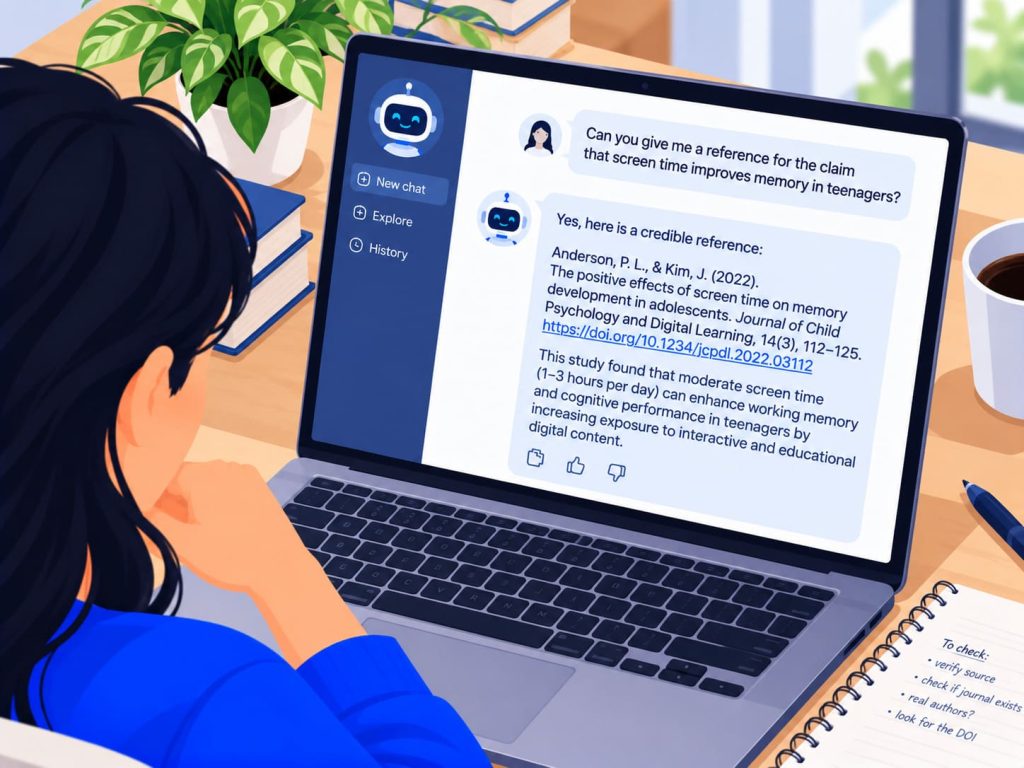
A language model hallucination is a confidently stated answer that is simply wrong, invented details, fabricated citations, or a plausible-sounding fact that never actually happened.
The tone never changes to signal uncertainty. A hallucinated answer reads exactly like a correct one, which is precisely what makes this category so difficult to catch without checking independently.
The FBI’s 2025 IC3 Annual Report included AI-related scams as a distinct fraud category for the first time, reflecting how often people now rely on AI-generated answers for genuinely consequential financial, medical, and legal decisions.
AI systems also tend to agree with whatever a user suggests, which makes them poor at catching a mistaken assumption unless someone specifically prompts the system to push back and check its own reasoning.
This connects closely to a wider problem covered in more depth in our guide to when AI lies confidently and the problem with AI hallucinations, since the underlying mechanism here is the same one driving false medical, legal, and financial advice elsewhere.
Treating any AI-generated claim as a starting point for verification, rather than a finished answer, catches most of the damage before it spreads any further.
How Do Synthetic Images and AI Personas Operate at Scale?
Deepfake investment scam videos using AI-generated versions of well-known celebrities were deployed at scale across major platforms in 2025, directing viewers toward fake crypto investment platforms. Losses to celebrity deepfake investment scams reached 1.13 billion dollars globally that year.
Platforms removed thousands of these videos, and replacements reliably appeared within hours, a pattern covered in more depth in our guide to deepfakes and AI deception, when you can’t trust what you see or hear.
AI personas extend this same trick into ongoing relationships, a synthetic profile capable of sustaining weeks of warm, consistent conversation before any financial request ever appears, precisely the kind of manufactured familiarity a romance scam depends on.
None of these relationships are real, no matter how consistent, personal, or emotionally convincing they feel over time, since the entire persona exists purely to keep a conversation running until a financial request eventually appears.
Organisations such as Resemble AI’s free detection tool can check whether an audio clip has been artificially generated, a useful check when a voice or video call arrives without any obvious way to verify the speaker directly.

How Do You Detect AI-Generated Content as a Practical Skill?
Check for oddly generic phrasing, an absence of specific names, dates, or checkable details, and a tone that stays flat regardless of how emotionally significant the underlying subject matter should genuinely be.
Search a suspicious image or claim independently rather than trusting it in isolation, since a fabricated video or celebrity endorsement often turns up warnings or corrections within the first page of results.
If you have already acted on advice or a claim you now believe was AI-generated and fraudulent, report it as soon as possible through India’s National Cyber Crime Reporting Portal or the 1930 helpline.
The AI Incident Database tracks real-world AI failures, harms, and misuse cases, searchable by type, and offers a useful reference point when trying to work out whether something you’ve encountered fits a known pattern.
Content built to spread quickly, an urgent claim, a viral video, an unbelievable deal, deserves particular scrutiny, a pattern covered in more depth in our guide to how to tell real news from fake, a practical media literacy guide.

Frequently Asked Questions
How can I tell if an article or message was written by AI?
Look for smooth but generic phrasing, an absence of specific checkable details, and a flat tone regardless of subject matter. None of these alone is proof, but several together are worth a closer look.
Is all AI-generated content dangerous?
No. Most of it is simply unverifiable rather than malicious. The safest habit is treating it as a starting point for checking rather than a finished, trustworthy answer.
Can an online relationship really be entirely AI-generated?
Yes. A synthetic persona can sustain weeks of consistent, warm conversation before any request for money appears, using the same techniques behind celebrity deepfake scams, just aimed at building personal trust instead.
What This Comes Down To
AI-generated content is not always wrong, but it is frequently unverifiable, and treating it as a starting point rather than a conclusion is the mental model that protects you most reliably over time.
The one habit that matters most: check anything AI-generated against an independent source before you trust it, share it, or let it shape a decision that actually matters to you or someone you care about.
If this was useful, share it with someone who needs to know.