

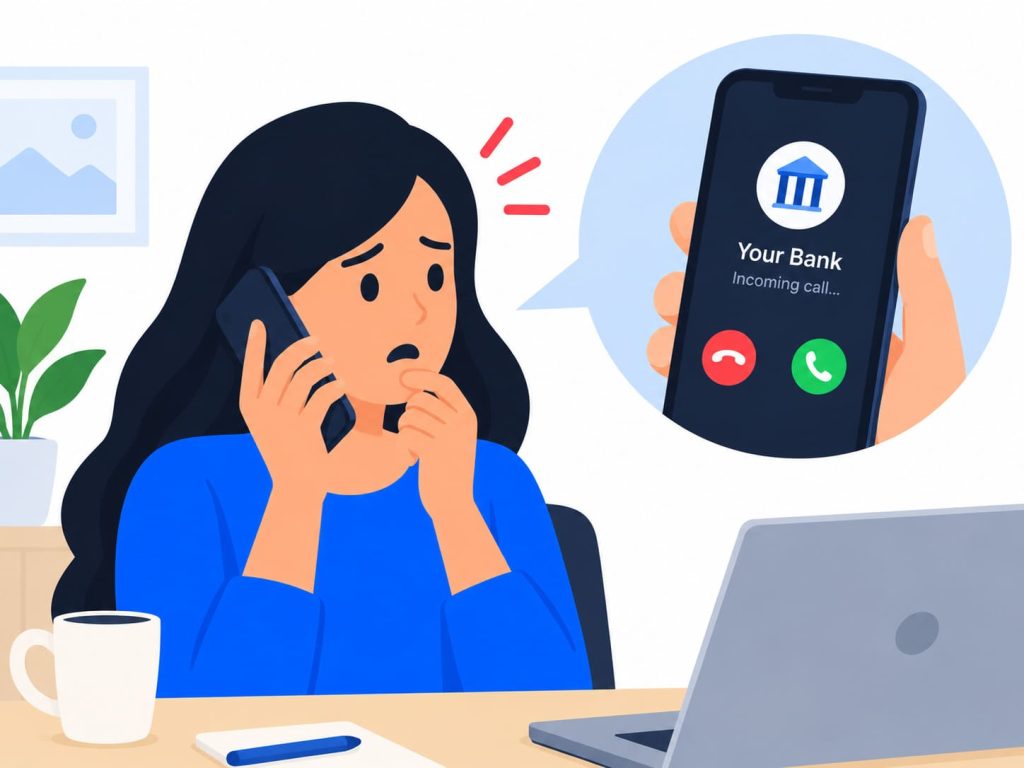
A fake bank call usually opens with something that sounds reassuringly specific: your name, the last four digits of your card, maybe a recent transaction read back to you.
The caller says your account has been compromised, and they need to verify your identity right now to protect it.
Everything about the call is designed to sound like the one call you would actually want to answer carefully. That is exactly the problem.
This post covers how these calls are built, how “verification” turns into an actual takeover, and precisely how to check whether a caller claiming to be your bank really is. It is part of our wider guide to the most common online scams.
How Are Banking Impersonation Calls Constructed?
The details that make a fake bank call convincing rarely come from thin air. Your name, phone number, and sometimes the last digits of your card are often part of a leaked or purchased dataset, bought cheaply and reused across thousands of calls.
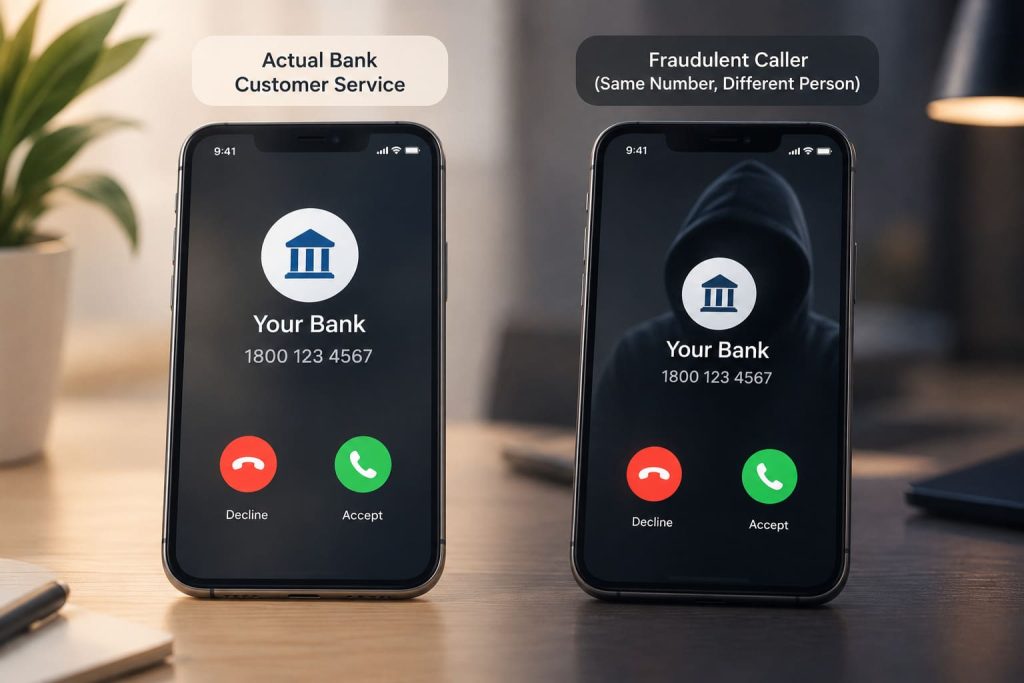
Caller ID spoofing lets the number displayed match your real bank’s genuine customer service line, which is why trusting the number on your screen alone is no longer a safe test.
The caller’s tone matters just as much as the details. A calm, official manner draws on the same instinct covered in our guide to why people obey scammers pretending to be authorities, since a confident voice claiming to represent your bank tends to override the hesitation a stranger’s request would normally trigger.
In India, the most common version claims your account will be blocked within hours over a pending KYC update, an unauthorised transaction, or a card that needs “re-verification.” The urgency is deliberate: a blocked account feels like an emergency worth acting on immediately, before you have time to check anything independently.
A second, related version starts as a text message with a link to a fake banking page, followed by a call if the link is not clicked, layering channels so that whichever one you trust gets used.
None of this requires the caller to have actually breached your bank. It only requires them to sound like they have, which is a far lower bar and one that a leaked phone number and a script can clear on its own.
How Does Account Verification Become a Social Engineering Attack?
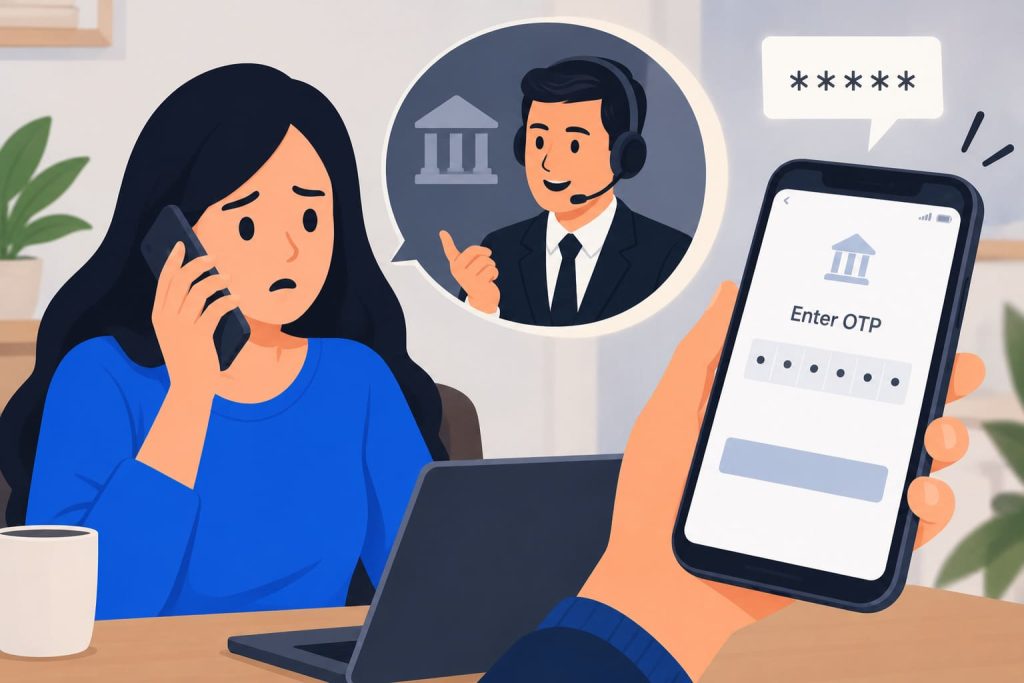
The call rarely asks for your password outright. Instead, it asks you to “confirm” details step by step, framed as routine security procedure rather than a request for sensitive information.
An OTP is requested to “cancel” a fraudulent transaction that was never actually happening. Reading that OTP out loud is, in practice, handing over the one thing standing between the caller and your account.
New York’s Attorney General filed a lawsuit in 2025 alleging that over a billion dollars was stolen from customers of a major US payment network through exactly this pattern, victims convinced their account was compromised and told to move funds to a “safe” account that was, in fact, controlled by the scammer. The mechanism travels well beyond the US: the same instruction to move money to a “secure” account appears constantly in Indian bank impersonation calls too, just through UPI or IMPS instead.
Payment confirmation scams work the same way in reverse: a fake “failed payment” or “refund pending” message prompts a call to a number that connects you straight to the scammer, who then walks you through “resolving” a problem that was manufactured specifically to get you on the phone.
What Happens to Your Account After a Successful Takeover?
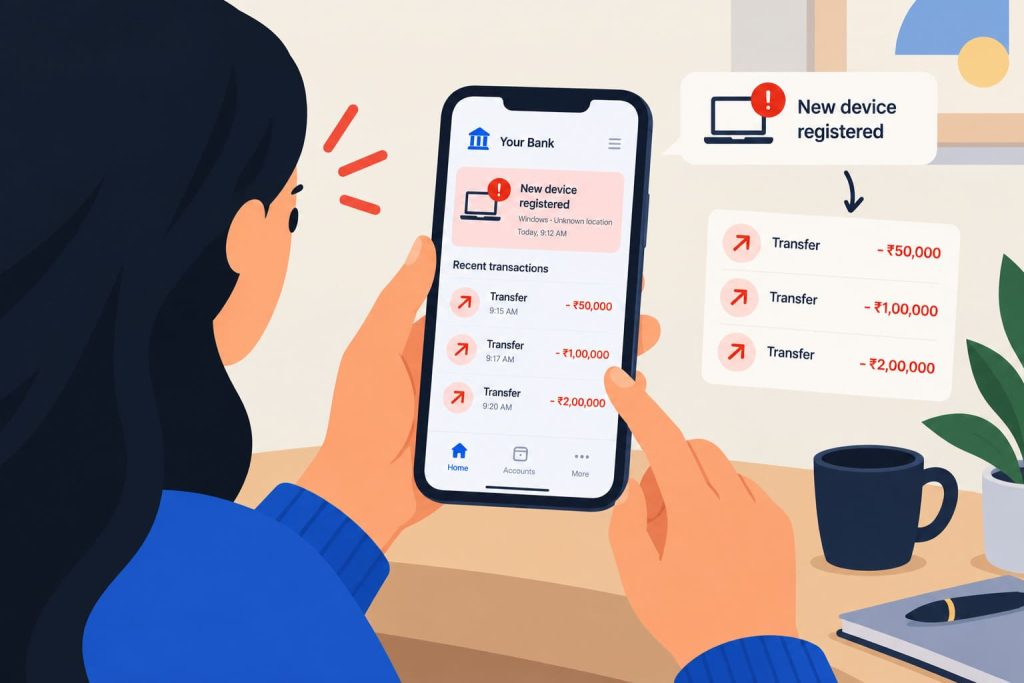
Once an OTP or password is shared, access can be near-immediate. A new device can be registered to your net banking or UPI app, transferring control before you have hung up the phone.
Funds are typically moved quickly, through several accounts in succession, specifically to make tracing and freezing the money harder the longer the transfer sits unreported.
Card cloning versions work differently but land in the same place, using details collected over the call to make purchases or set up recurring charges that continue well after the original call has ended.
All of this is the same reason a strong, unique password matters as much as it does, covered in more depth in our guide to why one weak password can cost you everything. A reused password across accounts means one successful call can unlock far more than a single bank login.
Authorised push payment fraud, where a victim is persuaded to transfer money themselves rather than have it stolen directly, became the UK’s leading banking scam type, according to the UK Finance Fraud Report, prompting regulators there to mandate reimbursement for victims from October 2024 onwards. India has no equivalent blanket reimbursement rule, which makes prevention, not recovery, the stronger line of defence.
How Do You Verify Any Caller Claiming to Be Your Bank?
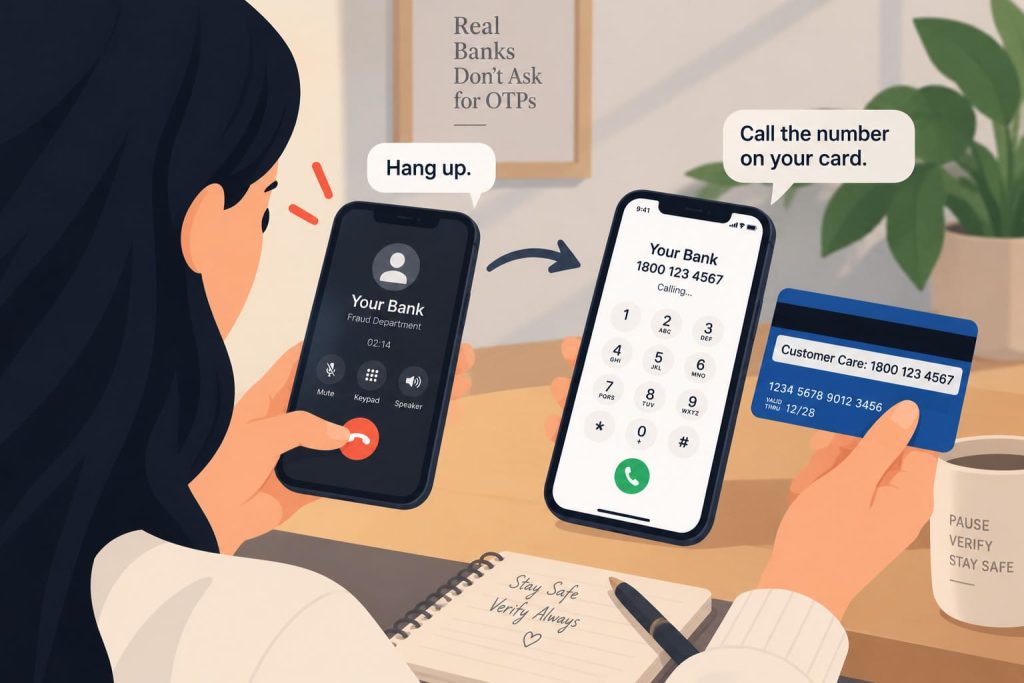
Hang up, and call your bank back using the number printed on your card or on its official website, never a number given to you during the call itself.
No genuine bank will ever ask you to read out an OTP, your full card number, or your net banking password over the phone. The Reserve Bank of India has repeatedly reminded customers that this information is never required for any legitimate verification call.
If the call came from a suspicious or spoofed number, you can report it through the Department of Telecommunications’ Sanchar Saathi platform. If money has already moved, contact your bank immediately to request a freeze, then file a report through India’s National Cyber Crime Reporting Portal or the 1930 helpline, since banks and cyber cells can sometimes stop a transfer within the first few hours.
It is worth setting up transaction alerts on every account you hold, if you have not already, since a text or push notification the moment money moves is often the fastest way to notice a takeover in progress rather than discovering it hours or days later.
Our guide on what to do after losing money to a scam walks through the fuller recovery process if reporting alone is not enough.
Frequently Asked Questions
Will my bank ever call and ask for my OTP or PIN?
No. A genuine bank never needs your OTP, PIN, or full password to verify your identity over the phone. Any call asking for these is a fake bank call, regardless of how official it sounds.
How can I tell if a call claiming to be my bank is real?
Hang up and call your bank back using the number on your card or its official website. Never use a number given to you by the caller, since spoofed caller ID can make a fake number look genuine.
What should I do if I already shared an OTP or password on a call like this?
Contact your bank immediately to freeze the account, then report it through cybercrime.gov.in or the 1930 helpline as quickly as possible, since speed significantly improves the odds of stopping a transfer.
What This Comes Down To
A fake bank call works by sounding exactly like the one call you would want to take seriously, using real details to earn trust it has not actually earned.
The one habit that protects you: hang up, and call your bank back yourself. No genuine emergency depends on you staying on that specific call.
If this was useful, share it with someone who needs to know.




2 comments
Comments are closed.