

A filter bubble does not arrive with a warning label, and most people never notice one forming around them until someone points it out directly.
When did you last read something that genuinely challenged an opinion you already held, and find it through your normal social media feed? For most people, the honest answer is rarely, or never at all.
It builds itself quietly instead, one recommendation at a time, until the view of the world reaching you has narrowed considerably without you ever noticing the narrowing happen.
This post covers why algorithms show you content that agrees with you, how a filter bubble isolates you inside a belief community, how polarisation gets amplified by this design, and practical ways to actually break out of your own bubble. It is part of our wider guide to how AI and algorithms quietly shape what you think and buy.

Why Do Algorithms Show You What Already Agrees With You?
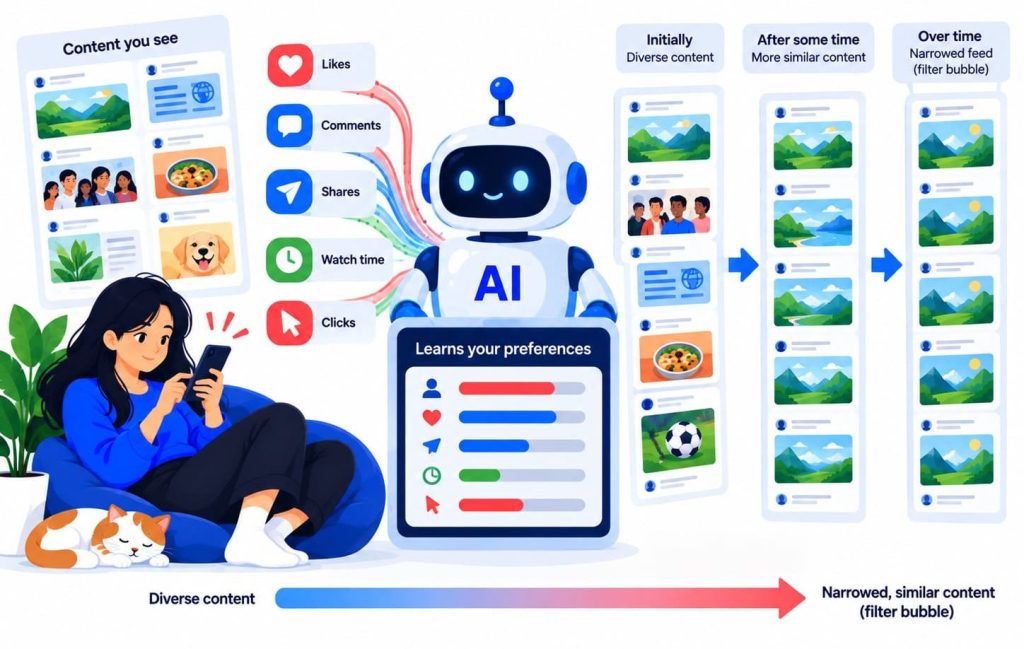
Content you engage with teaches the algorithm what to show you next, and content that confirms an existing belief reliably earns more clicks, likes, and time spent than content that challenges it.
This is confirmation bias operating at algorithmic scale, a naturally human tendency to favour agreeable information, amplified by a system built specifically to detect and repeat whatever keeps a person engaged the longest.
Instagram’s recommendation algorithm was found, through internal Meta research reinforced by 2025 congressional testimony, to actively amplify content that triggered strong emotional reactions, including content that increased anxiety and social comparison in teenage girls, because it drove longer engagement.
The algorithm optimised for time spent on the platform, not for a user’s actual wellbeing, a distinction that explains a great deal about why this narrowing tends to deepen rather than correct itself over time.
None of this requires a deliberate decision to mislead anyone. The system is simply doing what it was built to do, and what it was built to do is keep you engaged, not informed.
64 percent of industry respondents in 2025 cited AI and deepfake concerns as a top fraud threat, reflecting growing awareness that biased or manipulated algorithmic systems create risks well beyond any individual scam, according to Algorithm Watch’s research.
How Does a Filter Bubble Isolate You Inside a Belief Community?
Algorithmically curated feeds now account for over 70 percent of content consumed on major platforms, according to the Reuters Institute’s Digital News Report 2025, meaning most people see content chosen by a system rather than sought out through their own deliberate search.
Once inside a filter bubble, the same handful of perspectives keep resurfacing repeatedly in slightly different forms, creating an impression of broad agreement that may not reflect anything close to the actual range of views held outside it.
Missing contrary information entirely is the defining feature of this isolation, not a single blocked post, but an entire category of perspective that simply stops appearing in your feed at all.
Belief communities that form this way can feel entirely representative from the inside, even when they genuinely reflect only a narrow slice of the actual, wider range of opinion that exists on a given topic.
This connects closely to the wider pattern covered in more depth in our guide to how to tell real news from fake, a practical media literacy guide, since a narrowed feed makes misleading content within that bubble far harder to recognise as misleading.

How Is Polarisation Amplified by This Algorithmic Design?
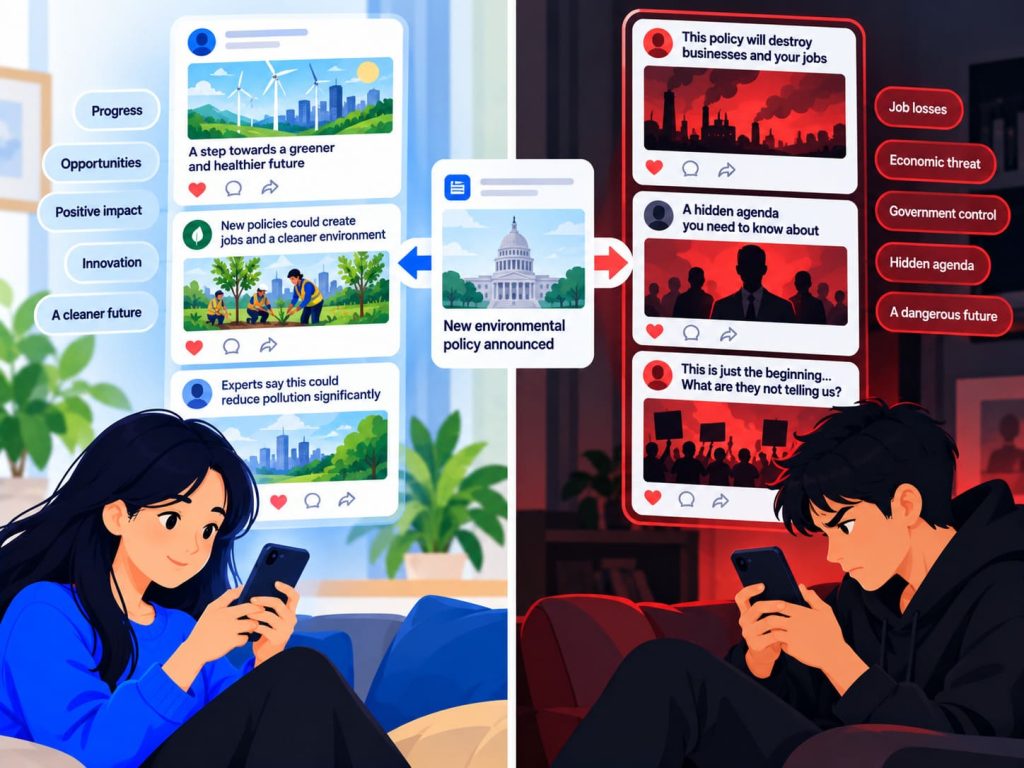
A feed that consistently reinforces one perspective makes the opposing view feel more extreme and less reasonable than it may actually be, since the moderate version of that view rarely gets shown at all.
Each side of a polarised debate can end up seeing only a caricature of the other, the loudest and most extreme voices from the opposing side amplified precisely because extreme content tends to generate the strongest engagement overall.
Political advertising exploits this same narrowing deliberately, a subject covered in more depth in our guide to how political ads are personalised to your fears without you knowing, since a microtargeted message is often built specifically to deepen an existing bubble rather than to inform anyone genuinely undecided.
Social comparison compounds the effect further, a subject covered in more depth in our guide to why social media makes you feel behind and how it’s designed to, since a narrowed feed often narrows the comparison group too, not just the opinions.
The algorithm is not showing you the world. It is showing you a version of the world calibrated to keep you engaged, and those two things are genuinely, meaningfully different.
What Are Practical Ways to Break Out of Your Algorithmic Bubble?
Deliberately seek out a credible source that consistently disagrees with your usual feed, and read it regularly enough that its perspective becomes familiar rather than jarring.
Following a handful of accounts with genuinely different viewpoints, rather than only unfollowing accounts you disagree with, does more to widen a feed than deletion alone ever manages on its own.
The Center for Humane Technology, founded by a former Google design ethicist, publishes accessible research and practical guidance on recognising and breaking out of exactly this kind of algorithmic narrowing.
Search a topic directly rather than relying entirely on what your feed surfaces, since a direct search tends to return a noticeably wider range of perspectives than a curated feed ever really will.
If you have already lost money or been misled by a coordinated campaign exploiting this narrowing, report it through India’s National Cyber Crime Reporting Portal or the 1930 helpline.
Notice when a piece of content confirms exactly what you already believed, and treat that moment specifically as a cue to look for the strongest opposing argument before accepting it fully.
Discussing a genuinely contested topic with someone outside your usual online circle, in person where possible, tends to surface nuance that an algorithmically curated feed rarely bothers to show either side.

Frequently Asked Questions
How do I know if I’m actually living in a filter bubble?
Notice whether your feed consistently agrees with your existing views and rarely surfaces a well-reasoned opposing perspective. If disagreement always feels extreme rather than moderate, that is a strong sign of a narrowed feed.
Can I actually escape this narrowing once it’s already formed, or is it permanent?
You can meaningfully reduce it. Deliberately following sources that disagree with you, and searching topics directly rather than relying on your feed, both genuinely widen what you see over time.
Is this the same thing as fake news?
Not exactly. A narrowed feed limits which perspectives reach you, while fake news is a specific false claim. The two often reinforce each other, since a narrowed feed makes misleading content harder to catch.
What This Comes Down To
A filter bubble narrows your view of the world quietly, optimised for your attention rather than for a balanced, complete picture of any given issue.
The one habit that helps most: deliberately seek out a credible, disagreeing perspective on a regular basis, and treat instant agreement with anything as a specific cue to look further before accepting it.
If this was useful, share it with someone who needs to know.


1 comment
Comments are closed.