
Priya is standing in a coffee queue in Bengaluru when her phone buzzes. This is where bank account fraud actually begins, not with a dramatic hack, but with an ordinary afternoon and an ordinary phone.
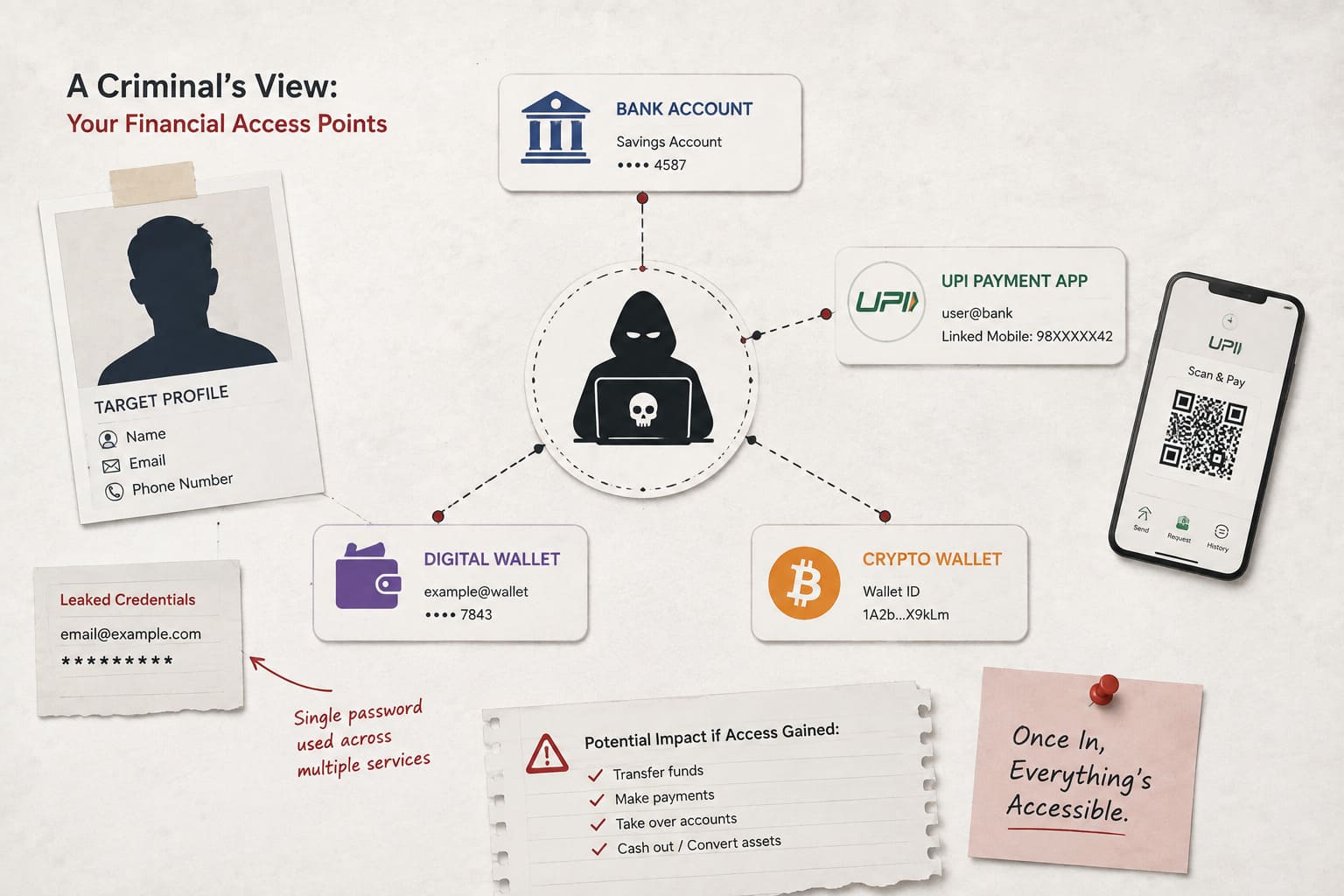
In her pocket she is carrying a bank account, a debit card, and the UPI app she opens fifteen times a day. There is also a little cryptocurrency she bought once and mostly forgot about. That is roughly what most working adults carry across their accounts on any given afternoon.
Criminals have mapped exactly the same list.
Bank account fraud is not one crime. It is a set of different attacks, each built for a different access point. The way someone empties a bank account through a fake phone call looks nothing like the way someone drains a UPI wallet, and neither looks anything like a cryptocurrency scam.
This post walks through what is actually sitting in your financial accounts, and how criminals approach each type differently. It also covers the handful of changes that meaningfully cut your exposure across all of them. If you want the bigger picture first, here’s what hackers actually want from you.
What’s Actually Sitting in Your Bank Account, Cards and UPI Apps?
Most people think of “my money” as one thing. In practice it sits across several different systems, and each one has its own rules and its own weak points.
Your bank account holds your salary and savings. A login, a PIN and, hopefully, two-factor authentication protect it.
A credit card works differently, since it is a line of credit with its own dispute process. That is one reason a stolen card number is often less damaging than a drained bank account.
Your UPI apps sit on top of your bank account. PhonePe, Google Pay, Paytm, your bank’s own app: all of them move money in seconds. So a compromised UPI app can empty the account behind it faster than you can read the notification.
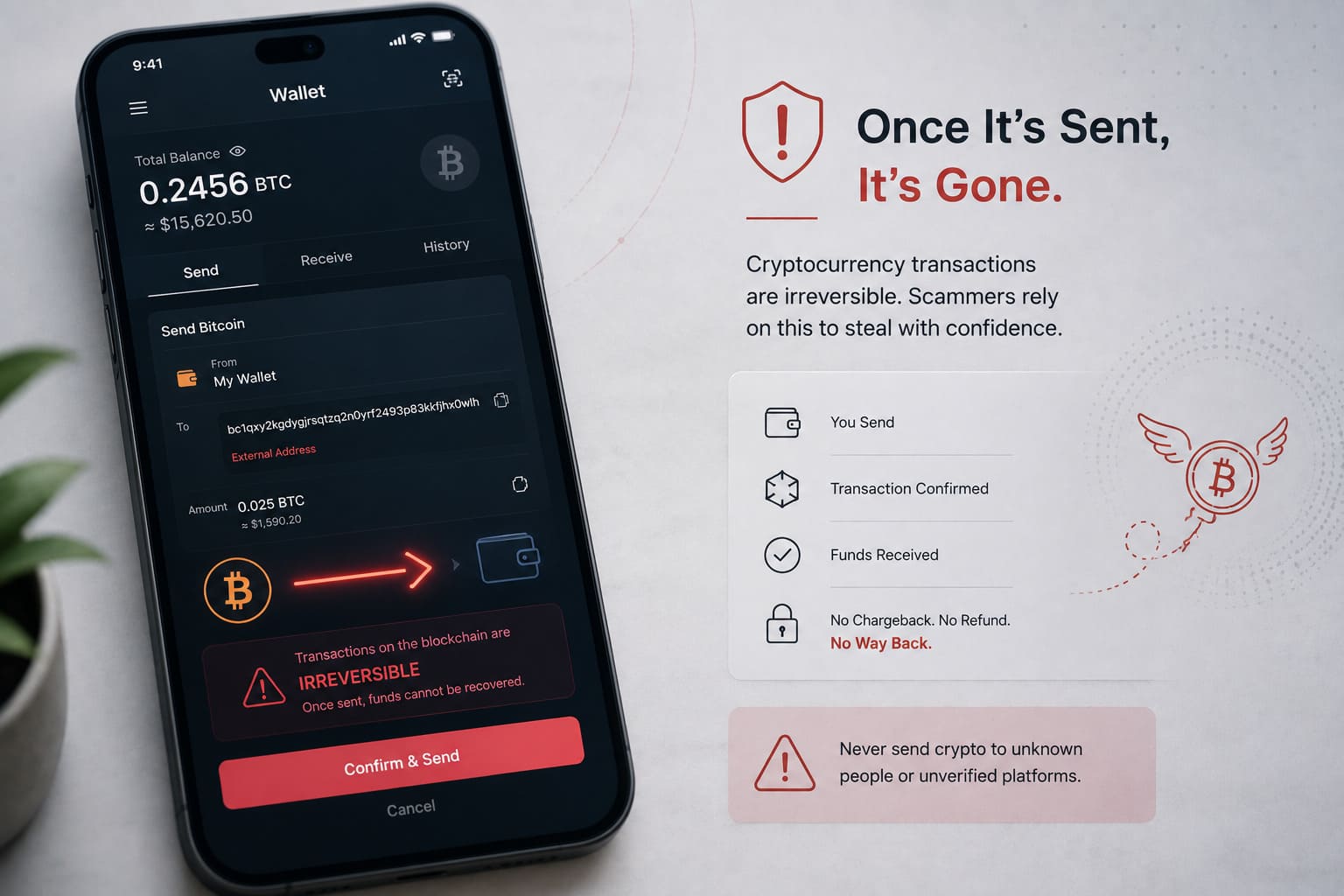
Cryptocurrency sits in a different category again. No bank stands between you and the transaction, and no dispute desk waits on the other side of it.
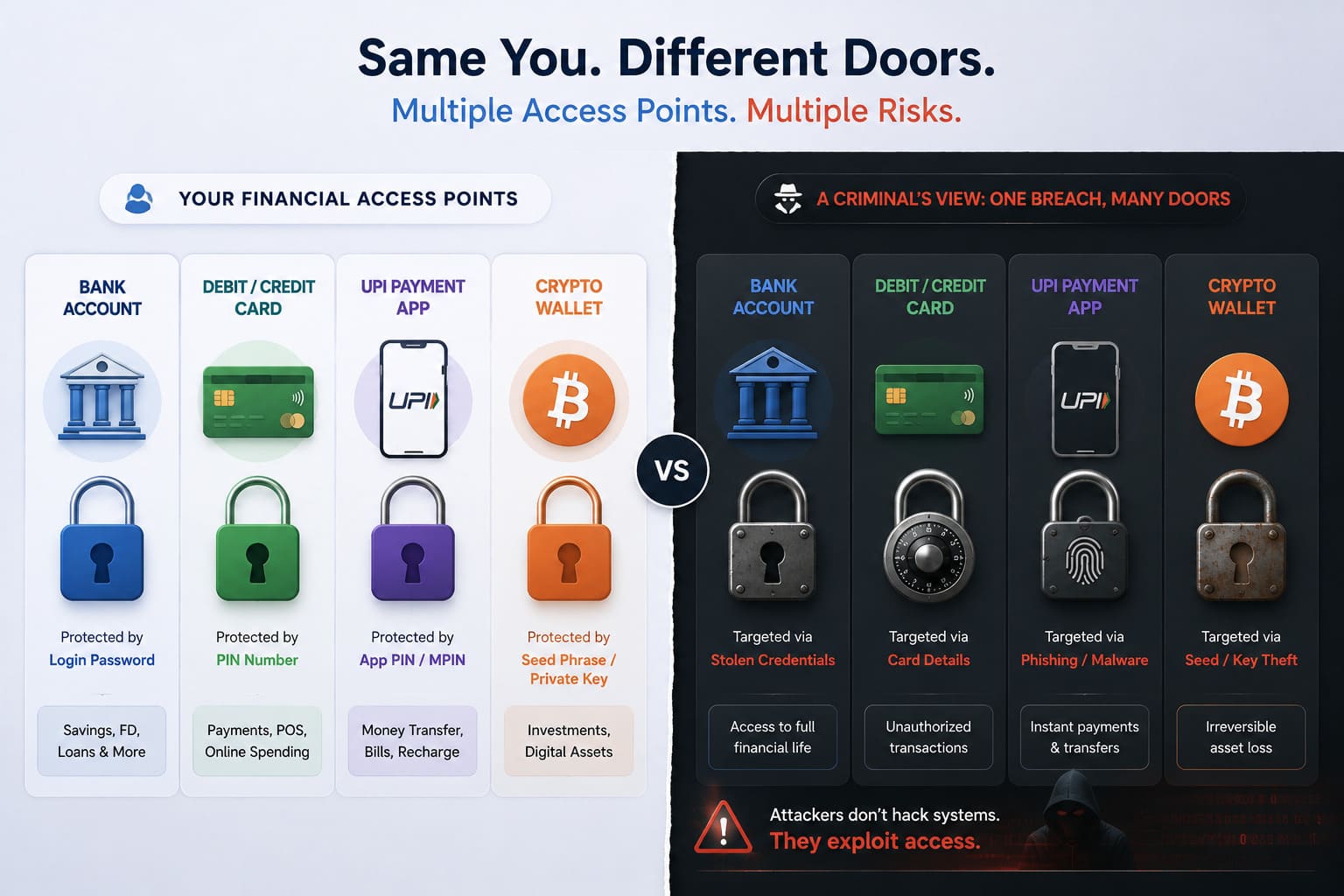
Each of these is a different door, and a different person can walk through each one. Someone who never speaks to you at all usually clones or skims a card. Someone who convinces you, directly, to move the money yourself usually drains a bank account.
Whoever controls your phone can drain the UPI app on it. Whoever gets your seed phrase, and only that person, can drain your crypto.
Criminals do not treat these as interchangeable, and that is exactly why bank account fraud rarely looks the same way twice.
How Do Criminals Actually Get Into Each One?
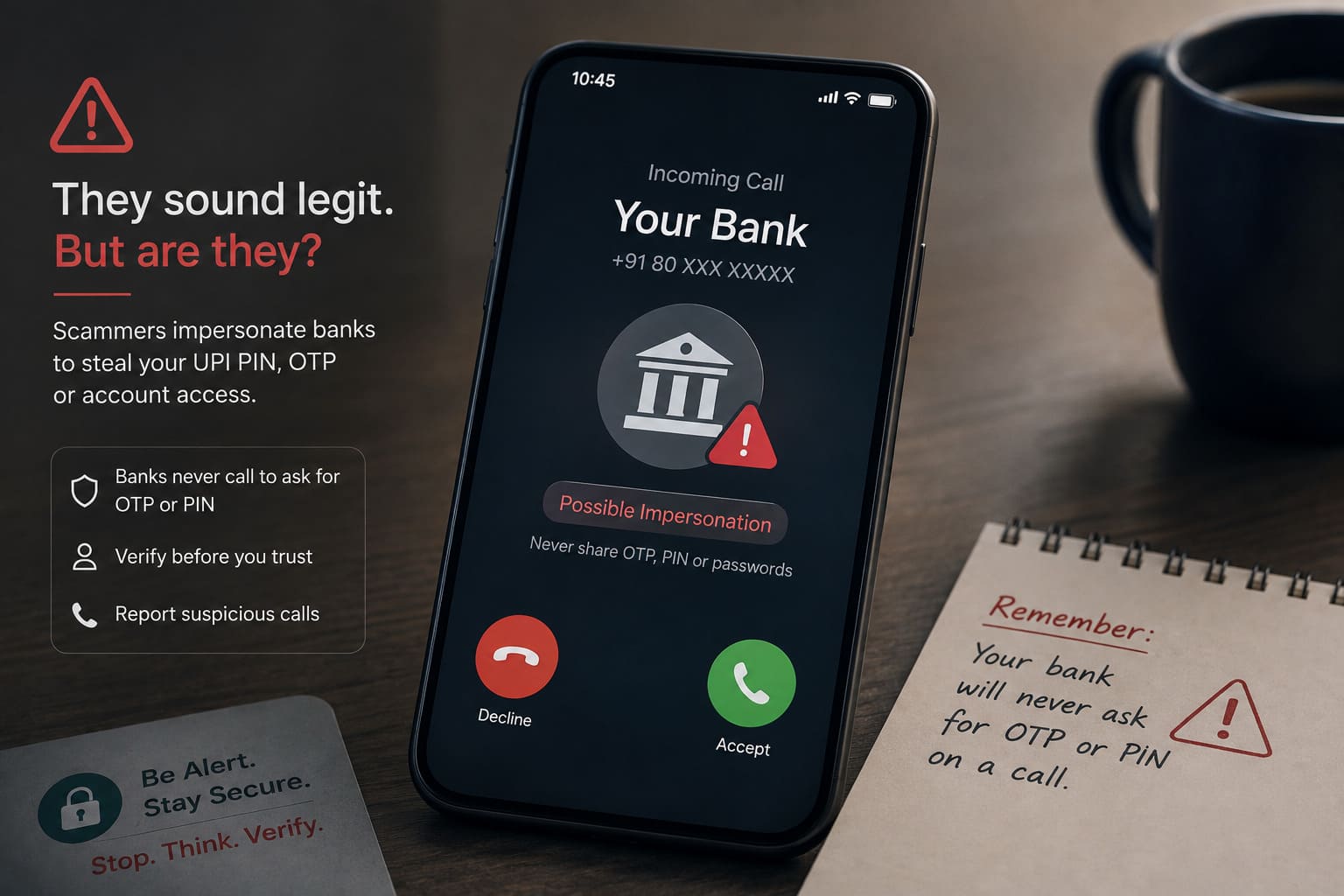
Impersonation, not brute force, usually targets bank accounts. A caller claims to be from your bank, says there has been suspicious activity, and asks you to “verify” your account.
Sometimes they ask you to move money to a “safe” account while they “investigate” the matter. That account belongs to them.
In August 2025, New York’s Attorney General sued the parent company behind the Zelle payment network in the United States. The lawsuit alleged that scammers used exactly this kind of impersonation to steal more than a billion dollars from users, roughly ₹9,650 crore at current exchange rates. One cited victim lost $1,476, about ₹1.42 lakh, to a fake utility billing account. Their own bank said the money was gone for good.
Cards get taken through a different route entirely. Cloning, skimming devices at compromised terminals, and numbers stolen in a data breach and resold all bypass you completely.
UPI adds a third layer of its own. Fake payment collect requests disguised as refunds, cloned merchant QR codes, and apps quietly linked to an existing card without the owner noticing all count here.
The weakest verification step in the chain, not the account itself, is what criminals actually target. That step is very often a phone call, not a hack. If a caller already sounds convincing, how fake bank calls set up account takeover is worth reading before the next one reaches you.
Why Does This Work, Even on Careful People?
None of this works because victims are careless. It works because the setup removes the one thing that would normally stop you: time to think.
A convincing caller creates urgency first. They tell you someone has broken into your account right now, which pushes you to act before you question anything.
Cryptocurrency scams use a different kind of pressure. The scammer shows victims a dashboard with fake, steadily rising gains. When they try to withdraw, the scammer asks for a “fee” or a “tax” first.
Investment fraud, much of it running through fake crypto platforms, was the single costliest online crime category in the United States in 2025. It caused $8.6 billion in reported losses, roughly ₹83,000 crore at current exchange rates, according to the FBI’s Internet Crime Complaint Center. That single category accounted for nearly half of all internet crime losses the FBI recorded that year.
Once crypto funds move to another wallet, they are gone. The transaction is permanent by design, and no dispute process exists behind it.
How Can You Tell When Something’s Wrong?
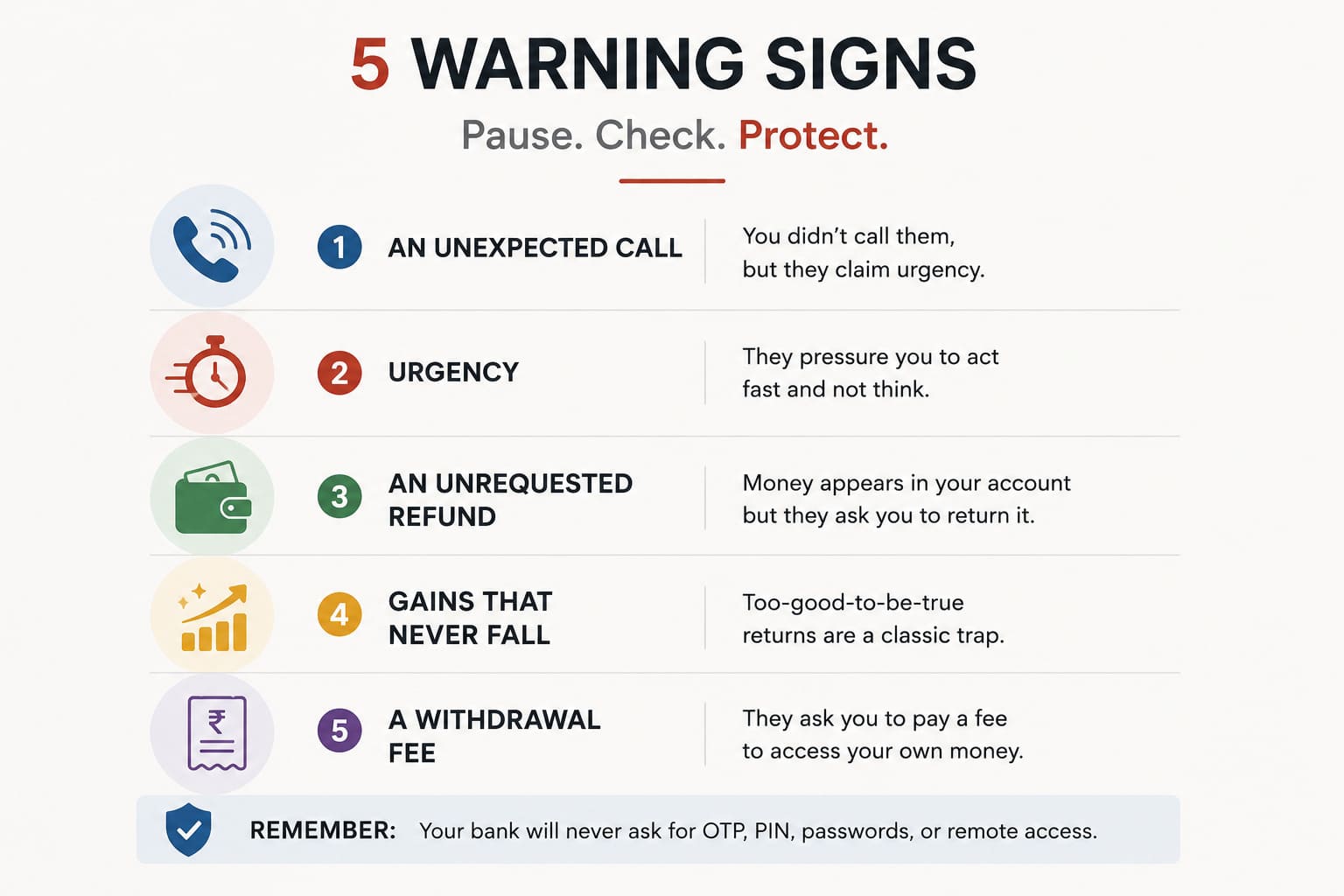
A few signals repeat across almost every version of bank account fraud, whichever access point criminals target.
The contact reaches you first. Your real bank rarely calls you out of nowhere asking you to “verify” anything urgently.
The caller pushes you to act before you can check anything. Genuine banks and payment apps do not need you to move money within minutes to stay safe.
A refund or collect request arrives that you did not initiate. Legitimate refunds never require you to approve a UPI payment request.
A platform shows gains that never seem to stop climbing. Real investments go up and down. A chart that only ever rises is not tracking a real market.
The platform demands a fee before you can withdraw your own money. No legitimate platform holds your funds hostage behind a new payment.
What Should You Actually Do About It?
You cannot make yourself unhackable, but you can make yourself a genuinely harder target.
Turn on transaction notifications for every account, card and UPI app you use. A message the moment money moves is the fastest way to catch bank account fraud while it is still reversible.
Never verify your identity to someone who called you first. Hang up, then call the number listed on your bank’s official website or the back of your card.
Keep your phone number itself secure too. A hijacked SIM can unlock everything downstream of it, which is why how SIM swap attacks take over your accounts is worth understanding before it happens.
Report the moment something looks wrong, since the faster a bank knows about an unauthorised transaction, the more it can still do about it. The CFPB’s consumer tools on bank accounts and cards set out what protections apply to each method. Indian readers can also report through the National Cyber Crime Reporting Portal or call the 1930 helpline.
Recovery is not guaranteed, and it works very differently depending on what criminals took. What your recovery options actually look like covers this in full, including the cases where money genuinely cannot come back.
Frequently Asked Questions
Can I get my money back after a UPI or bank transfer scam?
Sometimes, but it depends on the method and how fast you report it. Card transactions are usually easier to dispute. If a scammer tricks you into authorising a transfer yourself, it is much harder to reverse, since the bank sees it as a payment you approved.
Is a digital wallet safer than a bank account?
Not automatically. A UPI app or digital wallet usually sits directly on top of your bank account or card, so a compromised wallet can expose everything behind it. The safety comes from how carefully it is set up, not from the wallet itself.
Your money is reachable from more directions than you probably think about on an ordinary day, and criminals already know every one of them.
Start with one habit today: turn on transaction notifications for every account, card and UPI app you own.
If this was useful, share it with someone who needs to know.