
In 2025, criminals posing as IT staff called the help desks at Marks & Spencer, Co-op and Harrods, using social engineering tactics rather than any technical exploit.
They asked for a password reset. That was the entire attack.
M&S lost an estimated £300 million in online sales and watched its share price fall nearly 7 percent. Nobody wrote a line of malicious code. Nobody broke through a firewall.
A person believed a story, and acted on it.
This is what social engineering tactics actually look like in practice. Not sophisticated hacking, just persuasion aimed at a human being instead of a machine.
Pretexting, the act of inventing a believable story to manipulate someone, now shows up in more than half of all social engineering breaches, according to Verizon’s 2025 Data Breach Investigations Report. Most attacks of this kind succeed because of a fabricated scenario, not a technical trick.
The uncomfortable truth is that this works on everyone. It is not about intelligence or caution. It is about which psychological lever gets pulled, and when.
Ten of these levers show up again and again across scam calls, romance cons and workplace fraud: authority, urgency, shame, trust, obligation, greed, curiosity, helplessness, sunk cost and romance itself.
This guide walks through why a stranger who simply sounds official gets obeyed, then works through the other nine levers one at a time. Each one gets its own detailed guide further down. Here is the shared pattern first.
Why Every One of These Tactics Works the Same Way
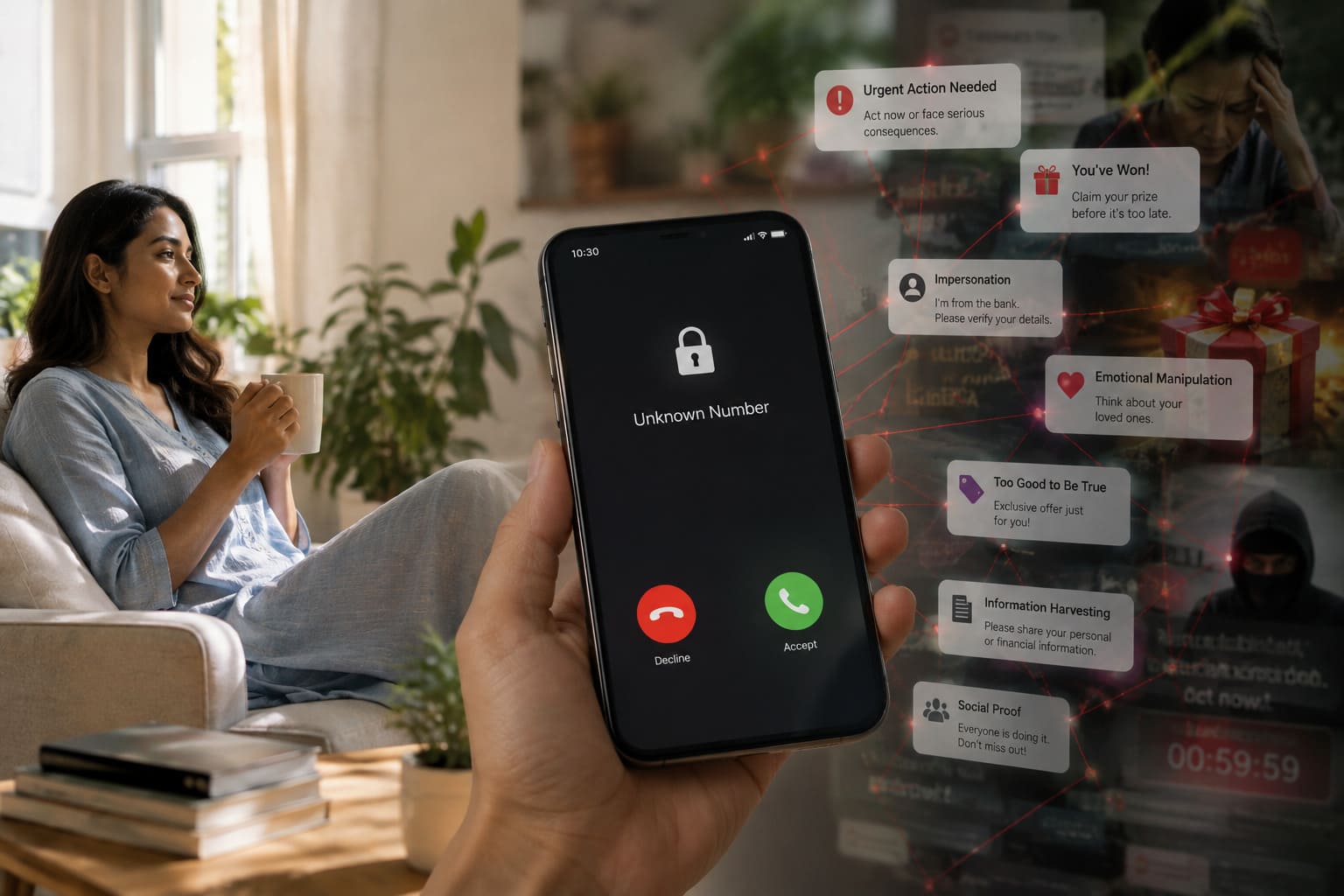
Ten different social engineering tactics, one shared mechanism: each pulls a lever that already exists in your brain for good reason.
Respecting authority keeps workplaces and societies functioning. Feeling urgency protects you from real danger. Trusting familiar faces lets you form relationships at all.
Every one of these tactics is a normal, useful piece of human wiring, turned against you.
Scammers do not need to invent anything new. They study what already works on people, then engineer situations that trigger it on command.
The callers who targeted M&S did not hack anything. They simply sounded like they belonged.
Real scams rarely use one tactic alone. A typical digital arrest call opens with authority, a fake police or CBI officer, then adds fear through an accusation or a threat of arrest.
Guilt or shame often follows, to stop the victim from telling anyone. By the time greed or curiosity gets added, several levers are working on the same person at once.
Understanding these ten mechanisms will not make you immune. Nobody is immune, including people who study this for a living.
What understanding does create is a gap between the trigger and your response. That gap is where verification happens, and verification is what breaks almost every one of these attacks.
None of these social engineering tactics require special equipment or rare skill from the person using them. A phone, a believable script and a target who is busy, tired or scared is usually enough.
That is also why the fix does not require special skill from you either. Recognising the tactic while it is happening is most of the work.
Why Do People Obey a Stranger Who Just Sounds Official?
Authority bias is not a flaw. Most of us were taught it from childhood: listen to the police officer, the doctor, the person with the title.
Scammers manufacture that appearance from nothing. A spoofed caller ID, an official-sounding title and a copied logo are usually enough, and most people comply before they think to question it, a pattern the US Cybersecurity and Infrastructure Security Agency has documented across countless workplace intrusions.
The callers behind the 2025 attacks on M&S, Co-op and Harrods used exactly this approach. They sounded like colleagues from IT. Nobody checked.
Read the full guide: Why People Obey Scammers Pretending to Be Authorities

Why Does Panic Make You So Easy to Manipulate?
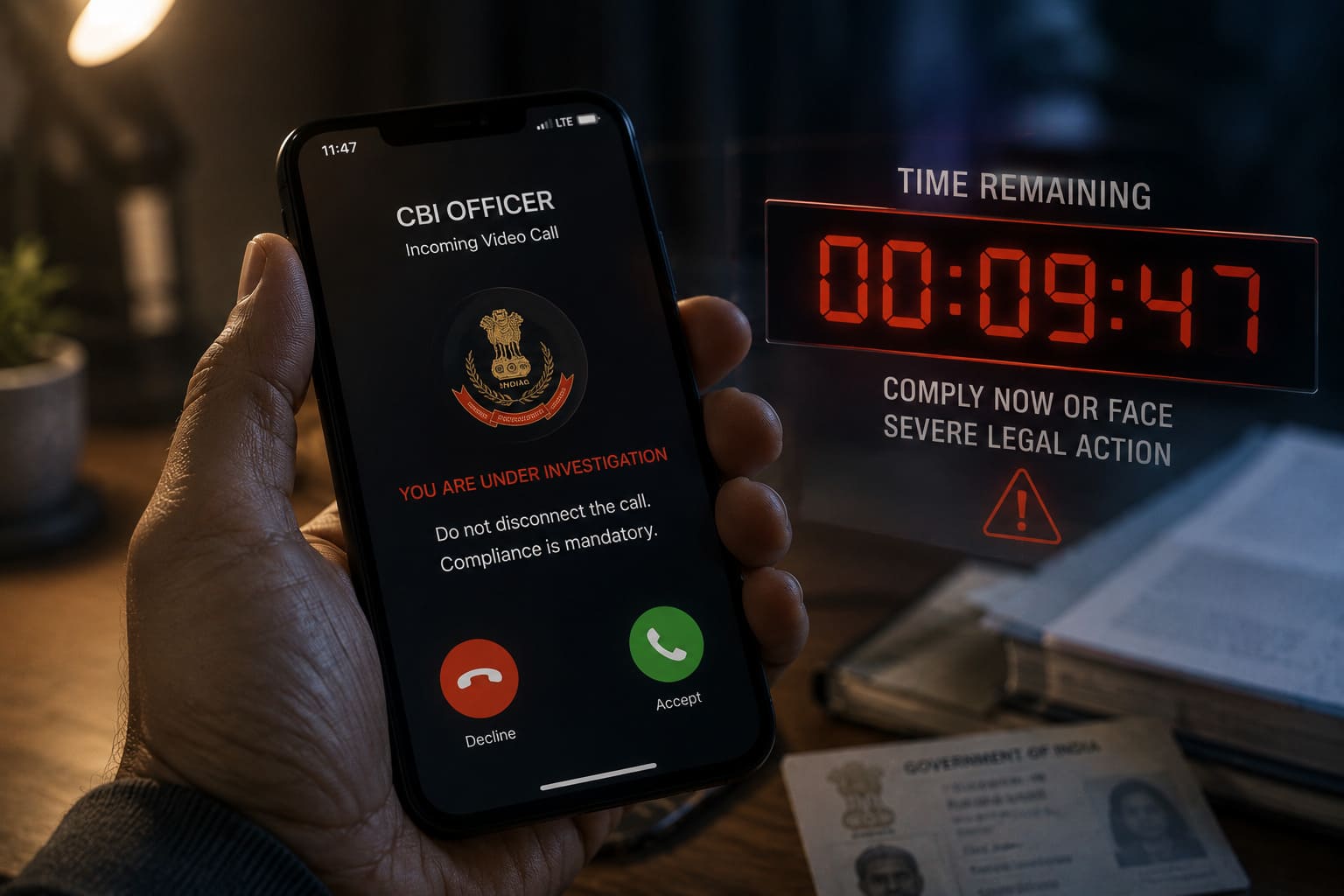
Fear collapses the time you would normally spend checking whether something is real.
Digital arrest scams show this at industrial scale. Callers claiming to be CBI or police officers tell victims they are under investigation and must stay on video call, sometimes for days, to stop them from verifying the story elsewhere.
These scams caused losses of ₹22,495 crore across India in 2025, according to the Ministry of Home Affairs. One 86-year-old woman in Mumbai lost more than ₹20 crore over two months, convinced she was under investigation for money laundering.
The fear rarely arrives alone. It is usually paired with a fake authority figure, since a threat lands harder when it seems to come from someone with real power to act on it.
Read the full guide: “Act Now or Lose Everything” — How Fear Is Used to Scam You
Why Do Victims Stay Silent Instead of Asking for Help?
Shame is the quietest weapon in a scammer’s kit, and one of the most effective.
Sextortion runs entirely on this principle. A threat to share an intimate image unless payment is made is timed so that embarrassment stops the victim from telling anyone who could help.
NCMEC received an average of 137 financial sextortion reports every day in 2025, a 37 percent rise on the year before, with most victims being teenage boys between 14 and 17. Its Take It Down service removes these images without the victim needing to share them with anyone else.
The shame was never the victim’s to carry. It belongs to whoever sent the threat.
Silence is exactly what lets the same tactic work on the next person too. Reporting it, even quietly, breaks that chain.
Read the full guide: How Scammers Use Shame and Embarrassment to Keep You Silent

How Do Scammers Get You to Trust Them This Fast?
Trust normally takes months to build. Online, scammers have learned to compress that timeline to days.
Warm-up conversations, fake reviews, borrowed profile photos and manufactured social proof all do the same job. They make a stranger feel familiar before any money or information gets requested.
Scam losses that began on social media reached 2.1 billion dollars in the US in 2025, with Facebook, WhatsApp and Instagram the three largest sources, according to FTC data. Reported losses starting this way were eight times higher than in 2020.
Feeling comfortable with someone is not the same as knowing they are trustworthy. Scammers are experts at creating the feeling without the reality behind it.
Read the full guide: How Scammers Build Trust Before They Strike
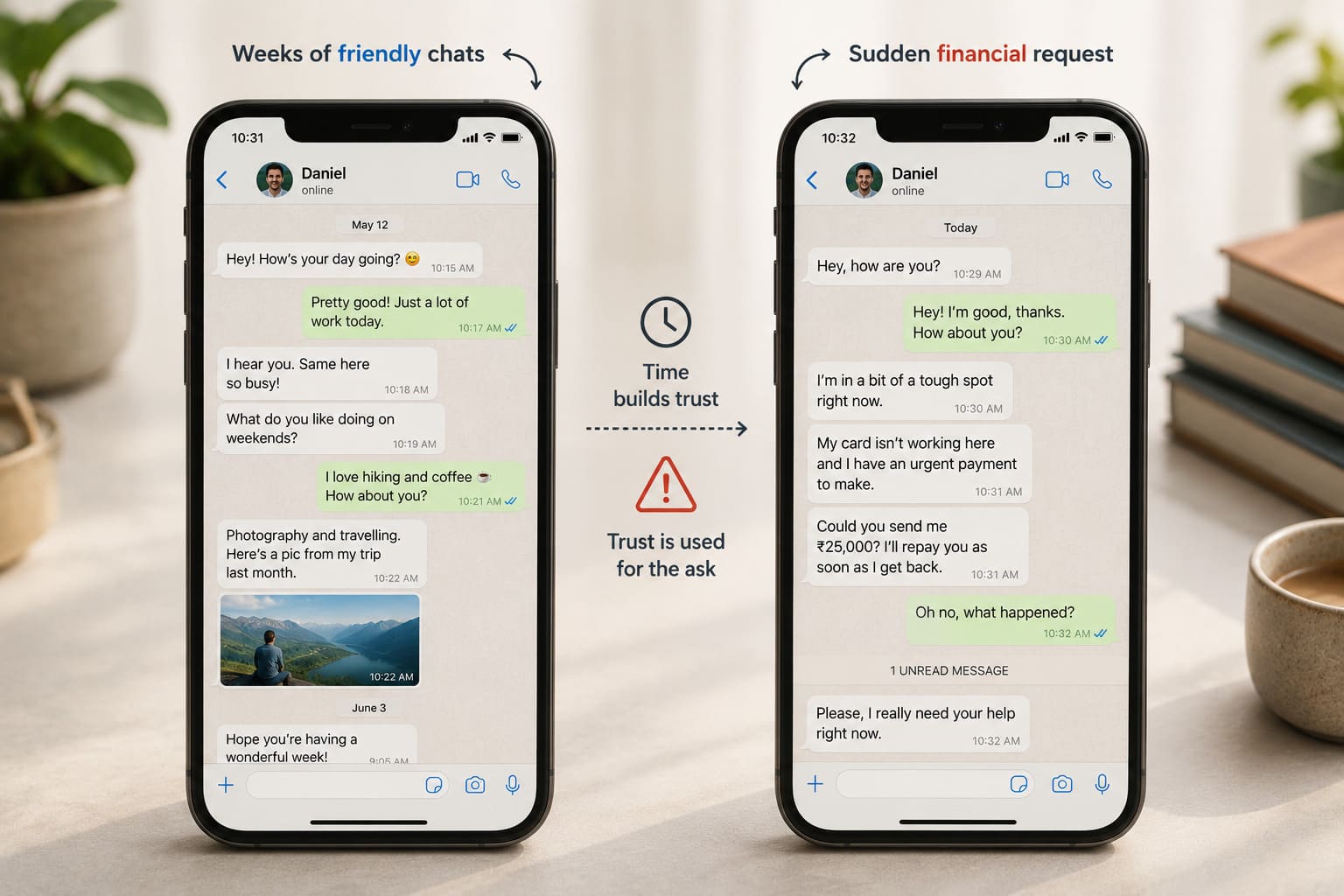
Why Do Scammers Give You Something Before They Ask for Anything?
Receiving something creates a genuine, deeply wired sense of obligation to give something back.
Pig butchering scams open with exactly this: friendship, warmth and small gifts of attention, weeks before any investment gets mentioned. The Global Anti-Scam Organisation has documented this playbook across thousands of survivor accounts.
These scams drove 8.6 billion dollars in US losses in 2025 alone. The average victim lost more than 38,000 dollars.
Read the full guide: Why Scammers Give Before They Ask — The Reciprocity Trap

Why Do Smart People Fall for Offers That Are Obviously Too Good?
Wanting a better outcome is not greed. It is hope, and everyone has some.
Crypto investment scams showed victims fake trading dashboards displaying large paper gains, then charged fees before any withdrawal, fees that led nowhere.
Investment fraud complaints grew 52 percent in 2025 according to the FBI’s Internet Crime Complaint Center, making it the costliest crime category that year. The US Securities and Exchange Commission’s investor alerts track many of these schemes as they emerge.
Excitement about an opportunity is normal. The stronger that excitement feels, the more it is worth describing out loud to someone else before acting on it.
Read the full guide: Too Good to Be True: How Greed and Scarcity Are Used Against You

Why Is It So Hard to Ignore a Message That Says “You Won’t Believe This”?
Curiosity is not carelessness. It is the same pull that makes you check a notification the second it appears.
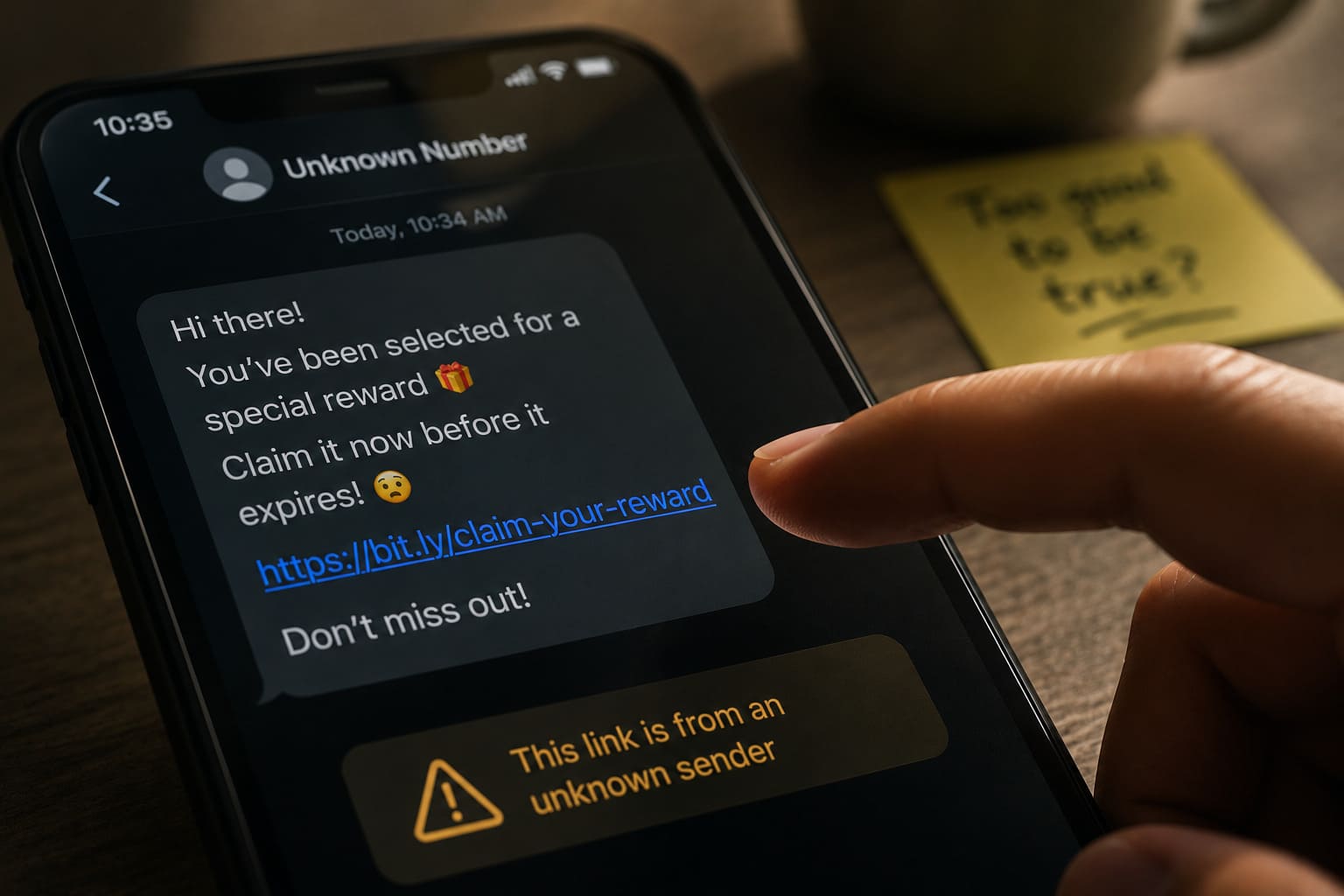
Scammers weaponise that pull with clickbait subject lines, USB drives left in car parks, and QR codes swapped onto real posters and menus.
In November 2025, Google alleged in a lawsuit that a China-based network built nearly 200,000 fraudulent websites in just 20 days, many relying on exactly this kind of curiosity bait.
Read the full guide: Why Curiosity Gets People Hacked — And How to Pause Before You Click
Why Do Confusing Pop-Ups Work So Well on Careful People?
Feeling out of your depth with technology is not a personal failing. It is something scammers deliberately manufacture.
A pop-up claiming your device is infected, paired with a phone number to call, exploits exactly this. The confusion itself is the attack.
Tech support scams cost Americans 1.464 billion dollars in 2025, an 87 percent rise since 2022, with people over 60 accounting for most of the losses, according to the AARP Fraud Watch Network.
Confusion is not a reason to be embarrassed. It is a condition scammers create deliberately, then offer to solve.
Read the full guide: How Scammers Exploit Confusion and Tech Overwhelm

Why Do Victims Keep Paying Even After Something Feels Wrong?
Once money has already been committed, stopping can feel like admitting the loss was real.
Rajni Goswami, a Napa resident, lost 300,000 dollars in a pig butchering scheme after matching with a scammer on OkCupid. She later said she kept going because she felt she had already committed too much to stop.
Every escalation in a scam like this is justified by the last one. The fresh eyes test, judging the current request on its own, with nothing already spent, breaks that cycle.
The money already gone stays gone either way. Only the next decision is actually still yours to make.
Read the full guide: The Sunk Cost Trap: Why Scam Victims Keep Paying

How Does a Scammer Build a Relationship That Feels Completely Real?
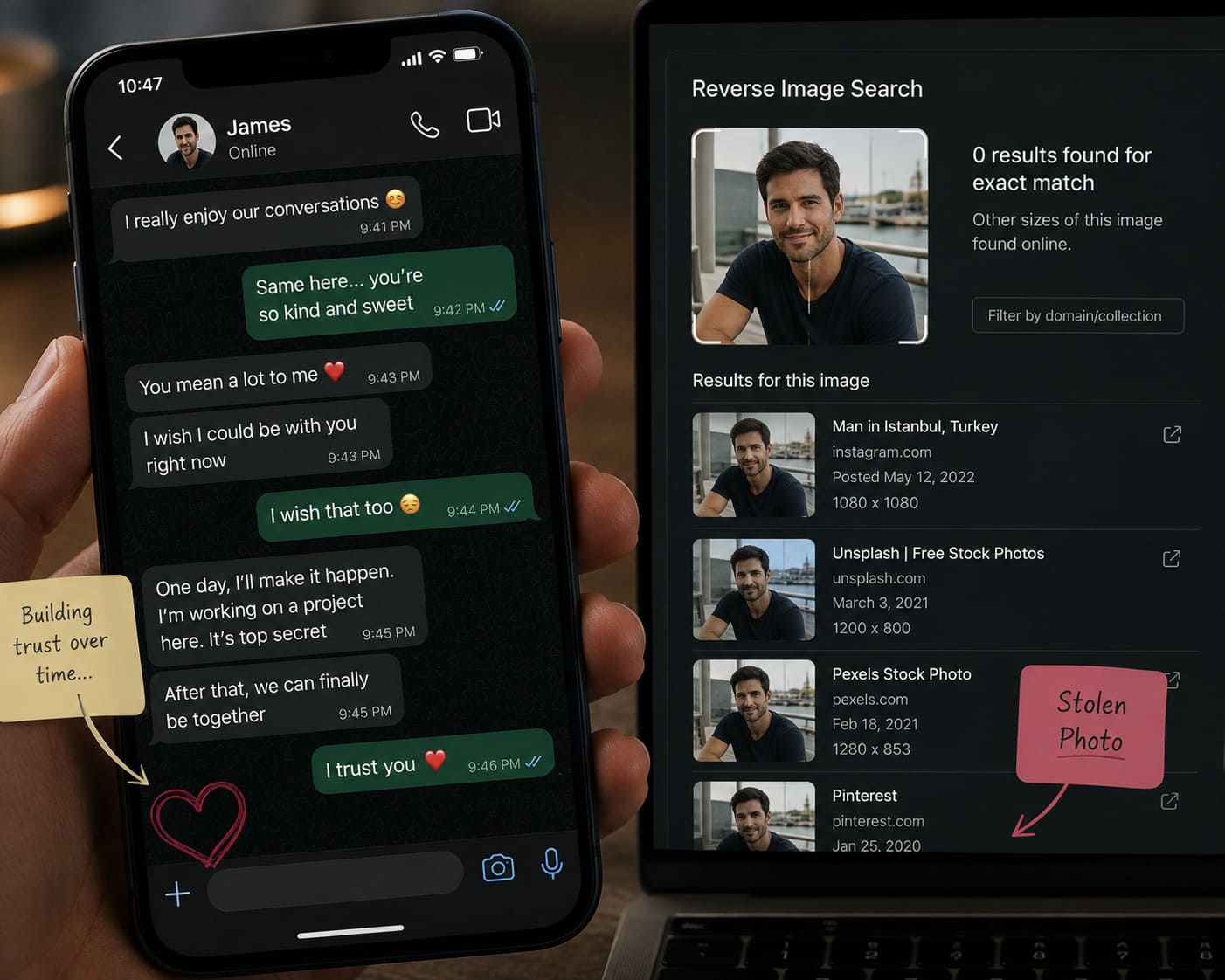
The person on the other side of the chat remembers your day, asks about your family, and seems to genuinely care.
Every part of that persona, the photo, the job, the backstory, may have been built specifically to earn your trust.
Victims across the FBI’s San Antonio division alone lost more than 28 million dollars to romance and confidence scams in 2025, nearly double the year before.
The feelings involved are usually real, even when the person creating them is not. That distinction matters more than any warning sign on its own.
Read the full guide: How Romance Scammers Build Fake Love Before Taking Everything
Frequently Asked Questions
Why do intelligent, careful people fall for these tactics?
Because social engineering tactics do not target intelligence. They target normal psychological responses that exist in everyone, including people who are highly educated and naturally cautious.
Scammers succeed by finding the right moment and the right lever, not by finding gullible people.
Can you train yourself to be immune to manipulation tactics?
Not completely, and nobody is. What you can build is a habit of pausing before you act on urgency, authority or a good offer.
That pause is what breaks most of these attacks, regardless of how convincing they feel in the moment.
Do scammers usually combine more than one of these tactics?
Almost always. A single call might open with a fake authority figure, add urgency within seconds, then introduce shame to stop the victim asking anyone else for a second opinion.
Recognising even one of the tactics in that stack is often enough to interrupt the whole sequence.
What to Remember From All Ten of These Tactics
Every social engineering tactic in this guide works the same way. It borrows something ordinary in you, trust, fear, hope or guilt, and points it toward someone else’s benefit.
That is not a character flaw. It is simply how people work, and scammers have studied it closely.
The shift that matters most is small. Before responding to anything that creates urgency, authority, guilt or excitement, pause.
Ten seconds is often enough to break the spell, and that single habit does more than memorising all ten tactics ever could.
If a stranger’s confidence has ever moved you to act faster than you meant to, start with how authority bias gets manufactured, then work through the rest in whatever order fits your own life.
If this was useful, share it with someone who needs to know.